About Eristalis cryptarum (Fabricius, 1794)
Morphological terms used here follow those defined for the morphology of Diptera. Eristalis cryptarum is 9–13 mm (0.4–0.5 in) in length.
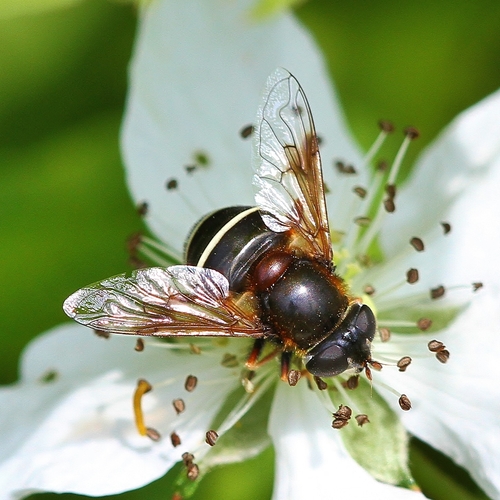
Head: In females, the lower portion of the frons is covered in yellow pilose; the upper sides of the frons are lightly pollinose and covered with black pile. Pile on the frons and vertex is yellowish, while pile around the ocelli is black, and sometimes the pile on the frons is also black. The face has a black base color, lightly covered with whitish pollen and pile on the sides. A wide black facial stripe sits on a pronounced tubercle. The gena (cheeks) are shining black, and the face is rather produced forward below. The third antennal segment (flagellum) is unusually large and bright reddish-orange. The arista is bare, the eyes are entirely covered in light pile, and the occiput is black above and white below.
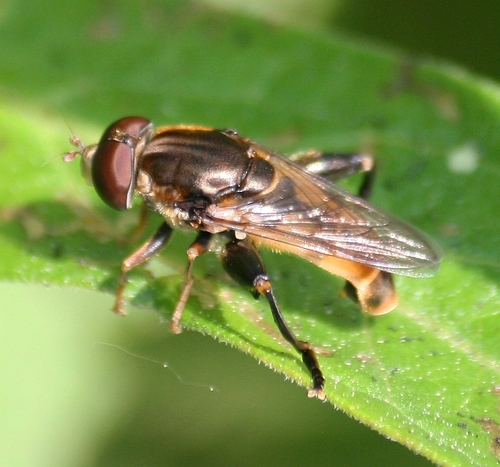
Thorax: The scutum is dark shining brown with reddish pile on the sides. The scutellum is reddish with black pile, and has reddish pile along its border. The pleurae are mostly covered with black pile.
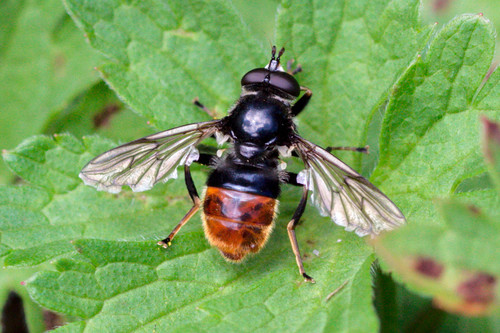
Abdomen: The second abdominal segment has roughly triangular reddish-orange or brownish-red markings on the sides that extend across the middle to form a continuous shining fascia, with deep opaque black elsewhere. The hind border of the segment is yellow. The pile on the colored spots of the second segment is bright golden red. The third and fourth abdominal segments are entirely shining black except for their yellow hind borders; the posterior part of the third segment is less distinctly shining and more subopaque. The hypopygium (fifth abdominal segment) is entirely shining black and has long white pile.
Wings: The wings are hyaline with black veins. The anterior portion, extending as far as the cross-vein and reaching a short way into the base of the second basal cell, is tinted brown, with a brownish band on the anterior basal portion of the wing. Diagnostic venation: a spurious vein (sv) is present, R4+5 loops into cell r4+5, cell r2+3 is closed, and the anterior cross-vein (r-m) located near the middle of the discal cell (dm) is oblique.
Legs: The legs are reddish with black pile. The basal portion of the femora is black, and the last three tarsal joints are black. The hind femora are black and not thickened. The tibiae are orange with yellow coloring at the base. Male genitalia of this species were illustrated by Hippa et al. (2001). The larva of Eristalis cryptarum has not been described.