About Eristalis anthophorina (Fallén, 1817)
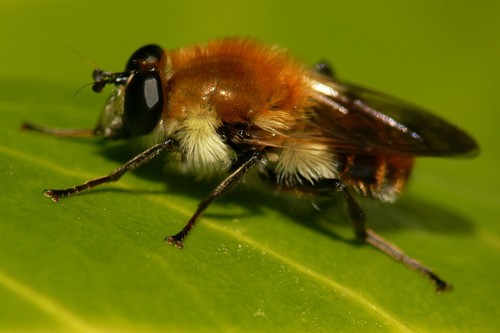
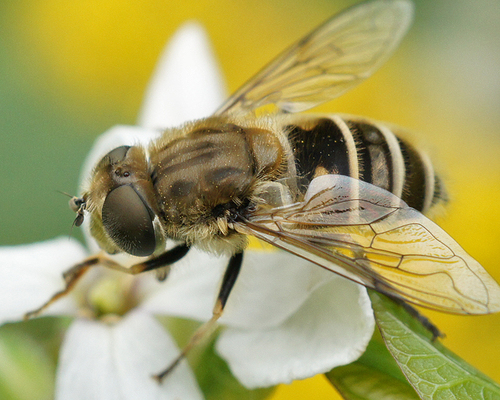
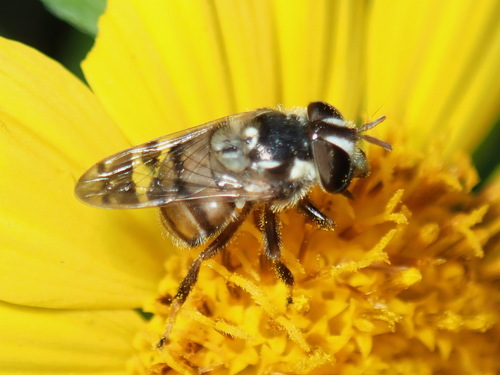
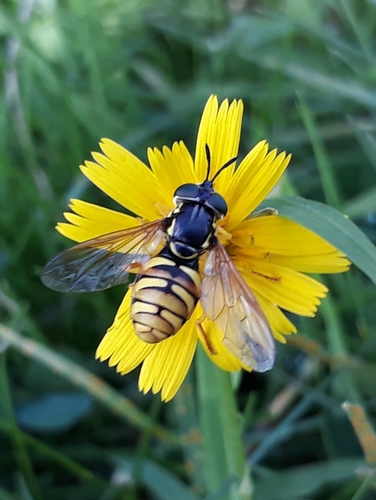
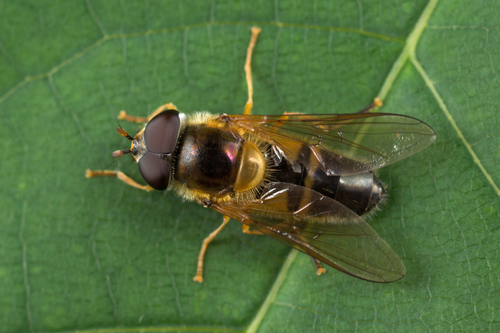
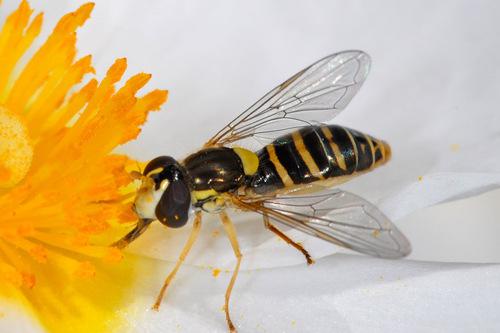
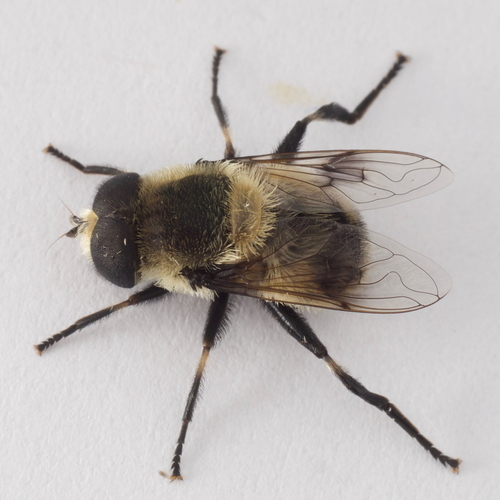
Eristalis anthophorina (Fallén, 1817) is a fly species that is easily confused with bumblebees, reaching approximately 15 mm (0.6 inches) in total length. On the head, the face is covered in reddish-yellow pollen, has sides covered in white hairs, a shiny black median stripe, and broadly black cheeks (gena). The antennae are black, with a reddish arista that is covered in fine hairs near its base. The eyes are entirely covered in hairs, and are holoptic in males. The thorax is black with long yellow hairs; the scutellum is entirely yellow, densely covered in yellow pile. The first abdominal segment is black, the second segment is broadly shiny with lateral orange spots, and the rest of the abdomen is black covered with long yellow-orange pile. The wings are nearly clear, with a dark brown stigmatic spot and a broad, distinct brownish spot in the center of the wing. Wing venation follows this pattern: the r4+5 vein is sinuous, cell r1 is closed, the anterior cross-vein (r-m) sits near the middle of the discal cell (dm), and is oblique. The legs are black with black pile, and the tibia are yellowish at their base. This species has a Holarctic distribution, and is widely distributed across northern North America and Europe. It is common in wetland habitats, including bogs, fens, and woodland pools. In North America, it occurs across most of Canada and primarily in the northern regions of the United States, and it may be an introduced species to North America. Individual Eristalis anthophorina have been observed visiting the flowers of Verbena hastata (blue vervain), Salix myricoides (blue-leaved willow), and Hesperis matronalis (dame's rocket).