About Eristalinus taeniops (Wiedemann, 1818)
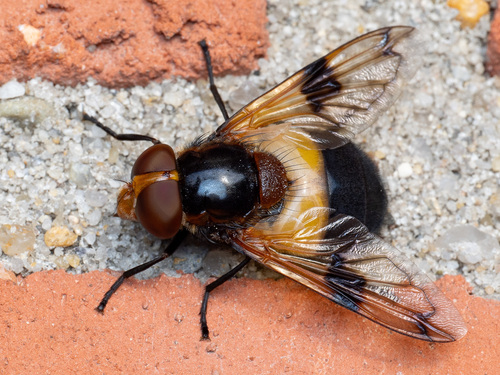
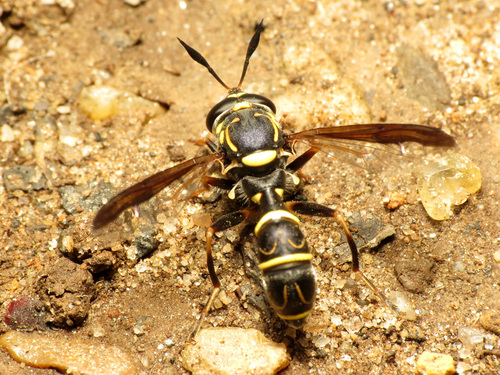
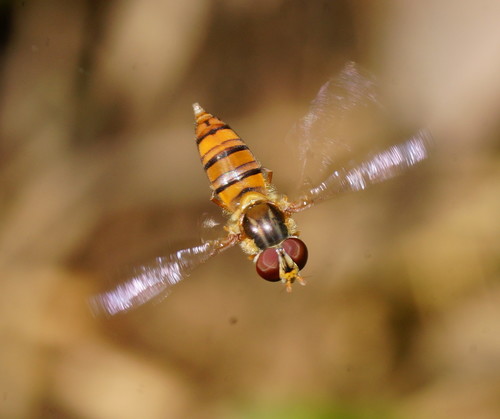
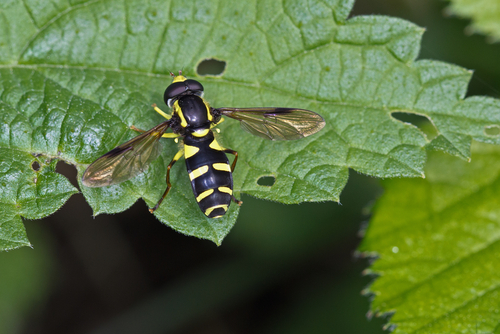
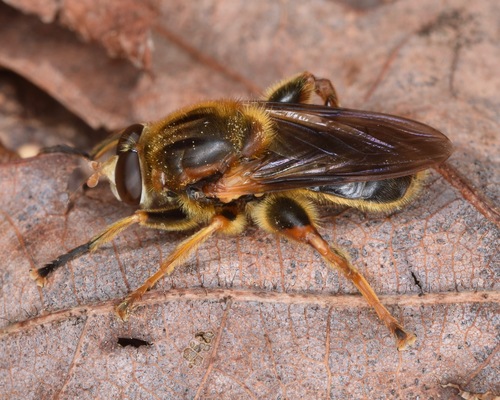
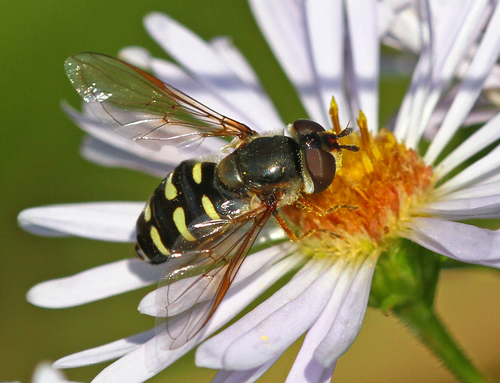
Eristalinus taeniops (Wiedemann, 1818) reaches a body length of 11–14 millimetres (0.43–0.55 in). These hoverflies have yellow and black coloration that resembles bees, a form of Batesian mimicry, so they are often mistaken for wasps or bees. The thorax is metallic yellow-brown and covered in dense yellow hairs, and the scutellum is also yellow-brown. The abdomen is reddish-yellow with transverse black bands. The compound eyes have five distinct vertical dark stripes. The wings are transparent, usually yellowish-brown at the base, while the halteres are a bright pale yellow.
This species is found in parts of Europe including Albania, the Balearic Islands, Bulgaria, the Canary Islands, Cyprus, France, Greece, Italy, Malta, North Macedonia, Poland, Portugal, and Spain. It also occurs in North Africa, the Near East (Turkey, Lebanon, Israel, Syria), the Caucasus, the eastern parts of the Afrotropical realm as far south as South Africa, the Oriental realm (Nepal, Northern India), Northern Pakistan, and Iran. It has been introduced to parts of North America, specifically California and Florida. More recently, the species has been discovered in Rio de Janeiro, Poços de Caldas, Curitiba, and Nova Maringá (Brazil), as well as Buenos Aires (Argentina). On March 25, 2025, this species was also found in the State of Goiás, Brazil.
These hoverflies inhabit holly oak forests, forest clearings, maquis, rivers, streams, and coastal marshes.