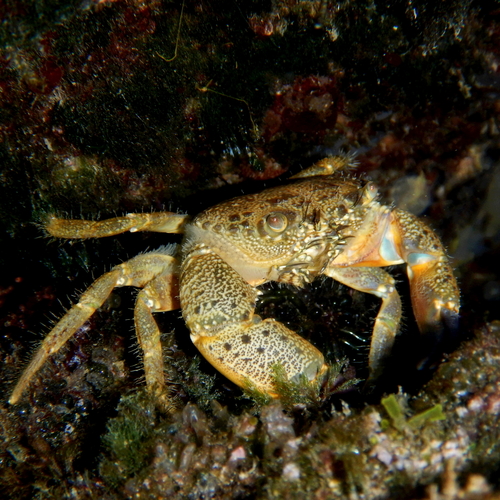
About Eriphia verrucosa (Forskål, 1775)
Eriphia verrucosa (Forskål, 1775) can grow up to 9 centimetres (3.5 in) wide and 7 centimetres (2.8 in) long. Its carapace is thick and smooth, and ranges in color from brownish-red to brownish-green with yellow spots. The front margin of the carapace has seven tooth-like projections on each side, and between five and six between the eyes. Its claws are strong with black-tipped fingers; usually one claw is larger than the other, the larger claw has rounded tubercles, while the smaller claw has sharper projections arranged in lines. In spring, E. verrucosa migrates to shallow water less than 1 metre (3 ft 3 in) deep, and reproduction starts in May or June. This species is highly fecund, with four distinct larval stages progressing from zoea to megalopa. E. verrucosa lives among stones and seaweeds in shallow water along rocky coastlines, at depths ranging from the shoreline down to 15 metres (49 ft). It has been recorded feeding on bivalves, gastropods, hermit crabs, molluscs, and polychaetes. In the Black Sea, E. verrucosa is the only native species that can break into the shells of the invasive snail Rapana venosa, though it is not considered likely to provide effective biological control for this invader. The species is currently threatened by eutrophication and water pollution.

