About Eriophorum scheuchzeri Hoppe
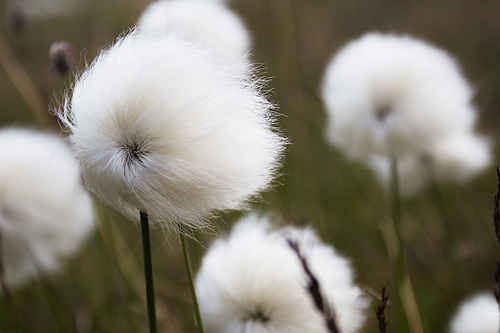
Eriophorum scheuchzeri Hoppe, commonly called Scheuchzer's cottongrass, is a perennial herb that forms colonies through spreading rhizomes. Its slender stems can grow up to 70 cm (28 inches) tall, though they are frequently much shorter. The species has rolled leaf blades that reach a maximum length of 12 cm (4.7 inches); leaves growing near the top of the stem lack blades entirely, and only feature black-tipped sheaths. The inflorescence is a single flower head, bearing wispy, cottony bristles that range in color from bright white with red tinges to silvery, and can grow up to 3 cm (1.2 inches) long. In the northern portions of its range, this plant occurs at sea level, while in more southern areas it can be found at elevations over 4,000 m (13,000 ft). It is a helophyte, limited exclusively to wet habitat types. It grows in marshes, wet meadows, along the shores of ponds and lakes, and on riverbanks, in moist to wet gravel and sand substrates. It often grows along the edges of standing water bodies, and is commonly associated with mosses and other sedges, including Carex aquatilis. Native and indigenous peoples have long known this plant and its uses. The Inuit use at least three distinct names for it: pualunnguat, which translates to "imitation mittens"; kumaksiutinnguat, meaning "an imitation object to remove lice"; and kanguujat in North Baffin, meaning "what looks like snow geese". The species has been used by people to make lamp wicks, boot insoles, and swabs. Its cottony flower heads have been used as wound dressings to absorb drainage from wounds. The plant itself is edible, and has a sweet taste. Muskoxen consume Eriophorum scheuchzeri Hoppe, and waterfowl feed on its seeds.