About Eriophorum angustifolium Honck.
Eriophorum angustifolium Honck. is a creeping rhizomatous perennial sedge that grows wild with many unbranched, translucent pink roots. Mature plants produce a tall, erect smooth green stem, which is shaped as either a narrow cylinder or a triangular prism. Reported heights of the species vary, with recorded ranges and maximums of up to 60 cm (24 in), 15–75 cm (5.9–29.5 in), and up to 100 cm (39 in).
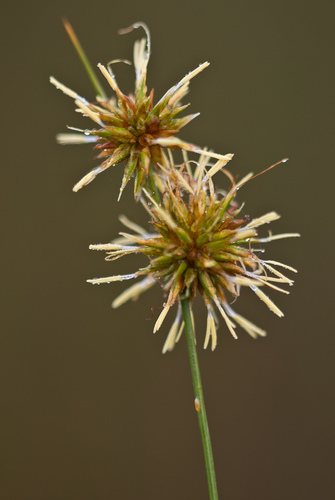
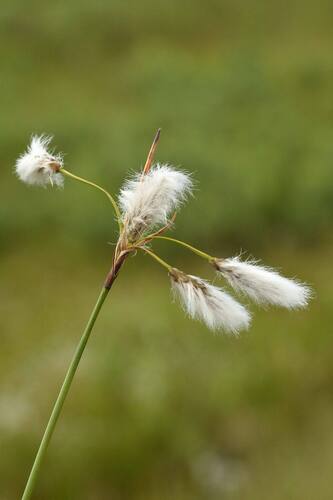
The species has stiff grass-like foliage made up of long, narrow solid dark green leaves. Each leaf has a single central groove, narrows from a 2–6-millimetre (0.08–0.24 in) wide base to a triangular tip. Up to seven green and brown aerial peduncles and chaffs, roughly 4–10 millimetres (0.16–0.39 in) in size, protrude from umbels at the top of the stem. After fertilisation, achenes develop each with a single pappus; these combine to form a distinctive white perianth around 5 centimetres (2.0 in) long.
Eriophorum angustifolium is described as a rather dull plant in winter and spring, but simply breathtaking in summer and autumn, when 1–7 conspicuous inflorescences made of hundreds of white pappi comparable to cotton, hair, tassels, and/or bristles stand out against naturally drab surroundings. The species differs from other members of the genus Eriophorum in both habitat and morphology. Its multiple flower heads and rhizomatous growth distinguish it from E. vaginatum, which has a single flower head and grows from dense tussocks. While E. latifolium also has 2–12 flower heads, it has laxly caespitose (tufted) growth and its pappi are forked. Smooth peduncles and a preference for acidic soil pH distinguish E. angustifolium from E. gracile, which grows in neutral pH swamps and has scabrid (rough) peduncles.
This species is native to the Northern Hemisphere, distributed across Eurasia, North America, and the British Isles. It grows in open bog, heath, wetland, and moorland with standing water, and tolerates both calcareous peat and acidic soil. It can survive in the Subarctic and Arctic, and is found as far north as 83° N in Alaska, Finland, and Greenland. British botanist William Turner Thiselton-Dyer recorded E. angustifolium in the South African Republic in 1898.
In North America, E. angustifolium ranges in the north from Alaska through Manitoba and the Canadian Prairies to Newfoundland and Labrador, down the Pacific Northwest to Washington state, across the Midwestern United States through Michigan and Iowa, down the Eastern Seaboard as far south-east as New York and New Jersey, and reaches as far south-west as New Mexico. In Eurasia, it is distributed across the Caucasus, European Russia, and North Asia including Siberia and the Kamchatka Peninsula, extending south-east to Manchuria and Korea. It grows throughout all of continental Europe except for areas within the Mediterranean Basin, reaching north into Scandinavia, and as far south as the Norte Region of Portugal and the Pierian Mountains of Greece.
Eriophorum angustifolium is the most common of the four native Eriophorum species in the British Isles, and has been recorded in every vice-county. It thrives particularly well in Ireland and northern and western regions of Great Britain, and is less common in southern and eastern areas. In the mires of Northern Ireland and the South Pennines, it is considered a ruderal, pioneer, and keystone species, because it can quickly colonise and repair damaged or eroded peat, encourage re-vegetation of its surroundings, retain sediment and landscape, and acts as a carbon sink. In central and southern counties of England, the species is rare or absent, and was completely destroyed in Cambridgeshire, The Broads, The Fens, and other parts of the East of England by human activities such as land reclamation. Within the British Isles, it thrives across a range of altitudes from sea-level fens and lowland meadows to exposed upland moors, when growing in acid bog or waterlogged heath. It has an altitudinal limit of 1,100 metres (3,600 ft) above sea level, reaching 854 metres (2,802 ft) in Ireland's Wicklow Mountains, and 1,060 metres (3,480 ft) in the Scottish Highlands.
Eriophorum angustifolium is a hardy, herbaceous, rhizomatous perennial plant, meaning it is resilient to cold and freezing conditions, dies back at the end of each growing season, has creeping rootstalks, and lives for over two years. It grows vigorously from seed over 2–5 years, and thrives particularly well in freshly disturbed, cut, or eroded peat. The species is protogynous. Sexual reproduction begins with flowering in spring or early summer, around May, when groups of 3–5 brown flowers form. Fertilisation usually occurs in May or June via anemophily (wind-pollination). The white bristle-like perianth, made of achenes with pappi (seeds with attached hairs), then grows outward to look like short tufts of cotton thread. These pappi remain through much of summer, lasting from around June to September. Like dandelion (Taraxacum) pappi, this structure aids wind-dispersal of seeds, and also acts as thermal insulation that traps solar radiation to keep the plant's reproductive organs warm. It is a known host to the fungal species Myriosclerotinia ciborium, Hysteronaevia advena, Lachnum imbecille, and Lophodermium caricinum.
The seeds and stems of Eriophorum angustifolium are edible, and are used in traditional Native American cuisine by Alaska Natives, Inuit, and Inupiat people. The leaves and roots are also edible; due to their astringent properties, they are used medicinally by Yupik peoples via decoction, infusion, or poultice to treat human gastrointestinal tract ailments. In the Old World, they are also used to treat diarrhoea. When growing in large abundance, this species can be dense enough to disguise wetland and bog, so it can be used as a natural indicator of hazardous areas to avoid travelling through. Attempts to make cotton-like thread from the seed-head hairs have failed due to their brittleness, but the plant has been used to make paper and candle wicks in Germany. It was also used as a feather substitute for pillow stuffing in Sweden and Sussex, England. In Scotland during World War I, it was used to dress wounds.
The Royal Horticultural Society notes that while Eriophorum angustifolium is difficult to grow under cultivation, it can be grown as a low-maintenance wildflower suitable for meadows, pond margins, or bog gardens. It can be grown in either sheltered or exposed terrain, and grows best in full sun at a south- or west-facing aspect, in water up to 5 centimetres (2.0 in) deep. It requires poorly-drained peat, sand, clay, or loam with an acidic soil pH. Division in spring is the recommended propagation method, and regular deadheading is the recommended pruning method. Suitable companion plants for cultivation include Narthecium ossifragum and Myrica gale. Eriophorum angustifolium is generally pest free. Seedlings and young plants are eaten by sheep, cattle, and a variety of goose species. It is tolerant to chalybeate (iron-enriched) water, but may be killed by powdery mildews.