About Eriophora pustulosa (Walckenaer, 1841)
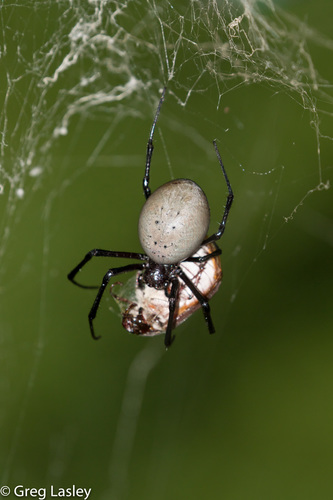
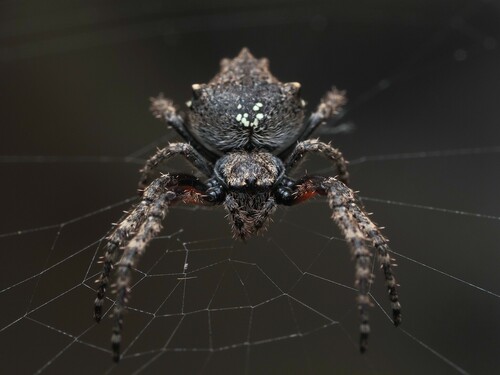
The species currently known as Eriophora pustulosa (Walckenaer, 1841) is also referenced as Socca pustulosa, a symmetric orb-weaving spider that represents a comparatively recent stage in the evolution of web-building. This species has several useful general distinguishing features related to abdominal shape: a roughly triangular abdomen with two noticeable humps towards the front, and five-pointed knobs on the upper rear of the abdomen. Most individuals have a leaf-shaped pattern covering the abdomen surface, and different individuals show remarkable variation in colouration. Their colour ranges from reddish-brown to yellow or even green, while some individuals have duller colours such as greys, whites, or pure black. Like many other spider types, female Eriophora pustulosa are larger than males: mature females have a body length of about 11 mm, which is almost twice the size of mature males at about 6 mm. Precise identification of E. pustulosa mainly relies on the fine anatomy of their reproductive organs. In males, the pedipalp has a unique tri-partite terminal apophysis. The terminal appendix is an elongated, sometimes threadlike apophysis located between two firmly sclerotised basal and apical lobes. In female genitalia, the epigyne plate appears roughly square-shaped in ventral view and has a broad atrium. The scape, which bears relatively long setae, is elongated and typically extends beyond the posterior margin of the epigyne plate. Mouthparts can also aid precise identification: the chelicerae have four teeth on the pro-margin and three on the retro-margin, which help the spider hold prey. This species is native to Australia, where it occupies large areas ranging from Tasmania in southern Australia, north through Victoria, New South Wales, and Queensland. It also occurs throughout New Zealand, and has been recorded on many other Pacific islands. It is presumed that E. pustulosa migrated to New Zealand from Australia via ballooning: the spiders use small silk strands as "balloons" to be carried by breeze. Today, this species can be found throughout New Zealand, and it is probably the most abundant species of large spider in the country. Its distribution in New Zealand includes the North Island, South Island, Chatham Islands, Campbell Island, and Bounty Islands. E. pustulosa prefers any open, sun-exposed vegetation habitat, and occupies a wide range of shrublands, forests, and even gardens. It rarely penetrates deep into dense native forests. The key factors shaping its habitat preferences are availability of prey, and the presence of enough structures to support dispersal and anchor its webs for hunting; suitable structures include tree branches, twigs, weeds, fences, and bushes. Anthropogenic landscape alteration and fragmentation from deforestation and urbanisation have created many new suitable habitats for this species. The life cycle of E. pustulosa begins with egg sacs. Mature females lay egg sacs during late summer or early autumn. A single egg sac can hold several hundred pink eggs, which the female wraps in an olive green silky cocoon. Surveys note that females may lay an additional egg sac on top of the first one, repeating the process, and occasionally rest on the egg sacs, presumably for protection. Juvenile spiders hatch from the eggs after approximately seventeen days and grow quickly. Spiderlings are fully capable of completing all steps required to spin webs without parental guidance, and most disperse via ballooning carried by natural forces. After E. pustulosa spiderlings molt (shed their juvenile skin) a number of times and become fully grown and sexually mature, most reach adulthood in summer and begin searching for mates. Once males reach sexual maturity, they lose interest in web building and preying, and instead focus on searching for a mate. To reproduce, males produce sperm in the abdomen then transfer it to the pedipalp; sperm is injected into the female's epigyne during copulation. After copulation is complete, the male leaves quickly to avoid being eaten by the female. The peak mating season occurs in summer, particularly on warm and humid evenings, and the mating period extends into the winter months if weather remains mild. After mating, the new generation of mature females lays egg sacs, and the life cycle restarts.