About Eriogonum umbellatum Torr.
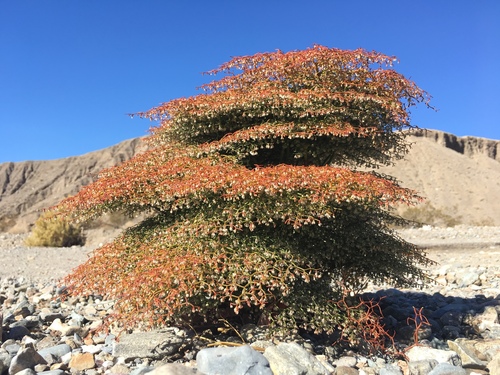
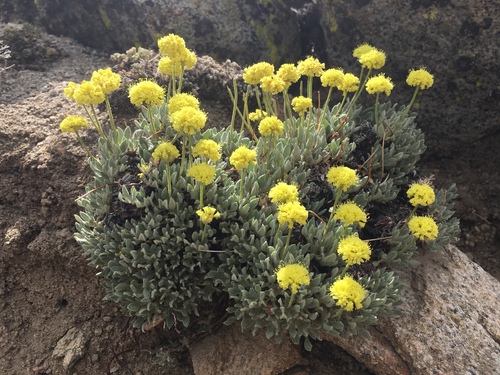
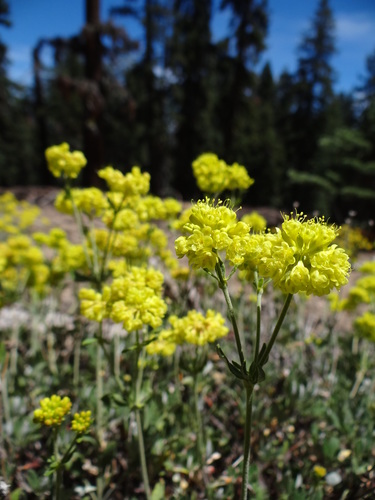
Eriogonum umbellatum Torr. is an extremely variable plant that can be difficult to identify, because individual plants vary widely in appearance and the species includes many different varieties. It is a perennial herb that blooms by summer. Growth forms can vary widely: some plants are perennial herbs reaching 10 cm (4 in) tall, with two to six flower clusters and a whorl of leaves located below the stems, while other plants grow as sprawling shrubs approaching 2 m (6 1/2 ft) in both height and width. Its leaves are typically woolly and grow low on the plant, and its flowers come in a wide range of colors, from white and bright yellow to purple. This species is native to western North America, ranging from California to Colorado to central Canada. It is abundant across this range and grows in a wide variety of habitats, including sagebrush steppe and alpine areas. Ecologically, it is a popular larval host plant that feeds the bramble hairstreak, desert green hairstreak, lupine blue, Mormon metalmark, Rocky Mountain dotted blue, Sheridan's hairstreak, Sonoran metalmark, and western green hairstreak. Goats and domestic sheep also feed on this plant. In cultivation, wildflower gardening author Claude A. Barr praised this species, called sulphurflower buckwheat, as "a treasure in appearance and in adaptation in my garden." It is valued for its very low water requirements for use in xeriscaping. The cultivar "Kannah Creek", a selected form of Eriogonum umbellatum var. aureum, has been introduced to the commercial garden trade by the Plant Select cooperative, which is sponsored by Colorado State University and Denver Botanic Gardens. This cultivar grows in USDA zones 4–8.