About Eriogonum thymoides Benth.
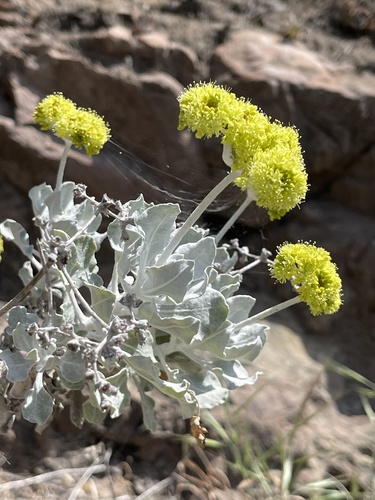
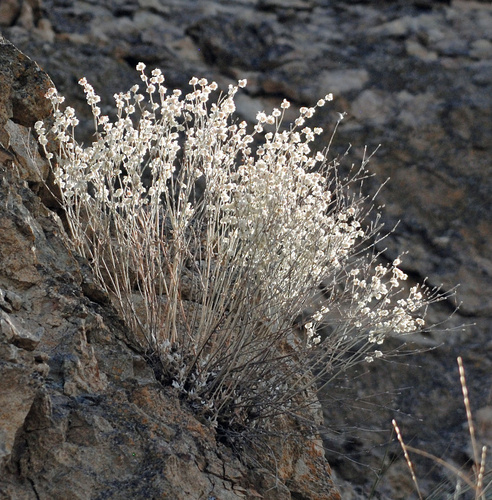
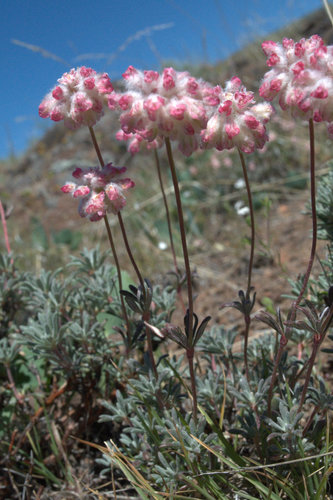
Eriogonum thymoides Benth. is an intricately branched subshrub. Its foliage grows up to 15 centimetres (5.9 in) tall and 40 centimetres (16 in) wide, and the entire plant is covered in short woolly or silky hairs. Young individuals usually have a very neat, compact appearance, while older plants may develop a gnarled woody base, grow somewhat taller, and sprawl extensively. Its hairy leaves range from linear to spatulate in shape, are flat or have edges rolled under, and reach up to 1.0 cm in length. This species produces erect flowering stems that grow up to 12 centimetres (4.7 in) above the foliage. Each flower stem has a whorl of small bract-like leaves near its midpoint, and is topped by a head-like inflorescence up to 2 cm wide. Individual flowers are up to 1 cm long, and vary in color: possible colors include yellow, white, rosy red, a mix of yellow and rosy red, and white. Flower buds are often deep rosy red. The bases of the petals and sepals are covered with long hairs. Eriogonum thymoides is polygamodioecious: some plants bear both male and bisexual flowers, while others bear both female and bisexual flowers. It can be distinguished from the similar species Eriogonum douglasii by its usually smaller leaves, and by its involucre lobes (the involucre is the bract that envelopes the base of the flower head). The involucre lobes are erect and appressed in E. thymoides, while they are spreading to reflexed in E. douglasii. The leaves of E. douglasii also tend to be flatter, wider, and more silvery in color. Eriogonum thymoides is native to dry regions of Idaho, Oregon, and Washington, in the Pacific Northwest of the United States, where it occurs in three main population groups. It flowers in mid-spring, and grows in sagebrush communities, ponderosa pine forest openings, and mountain ridges, often on very shallow rocky soil over basalt. Though it occupies a restricted range, it is locally abundant. According to one source, this plant has special value to native bees.