About Eriogaster lanestris Linnaeus, 1758
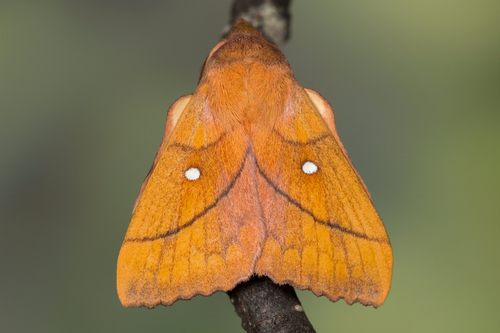
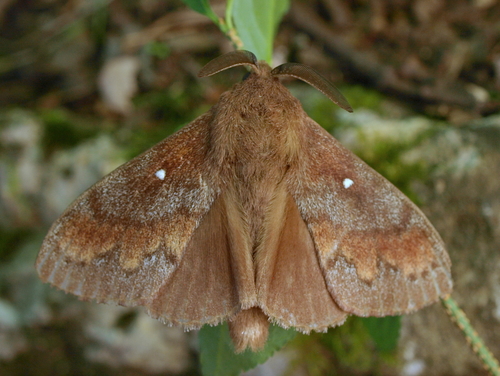
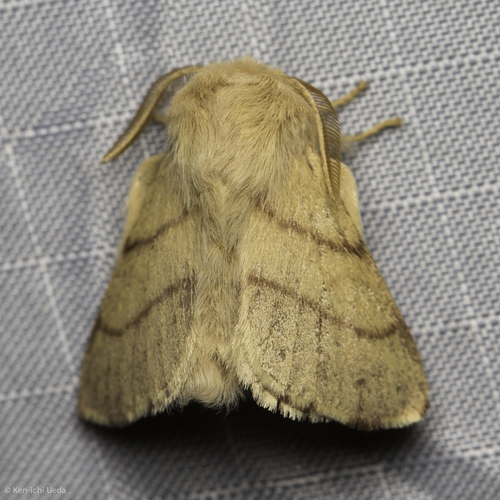
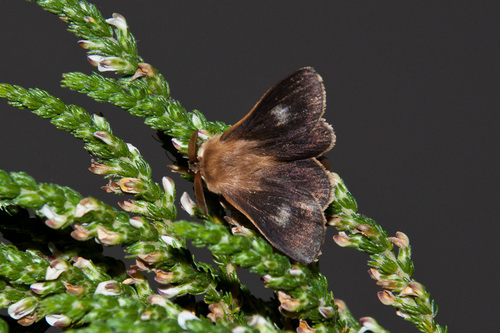
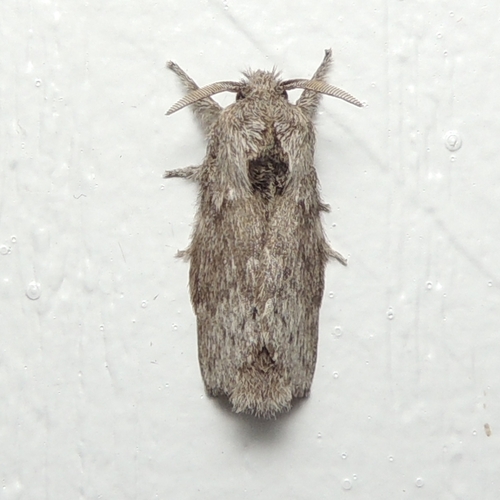
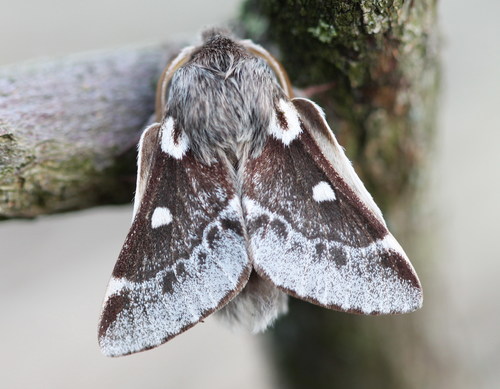
Eriogaster lanestris, commonly known as the small eggar moth, has an adult wingspan of 30–40 millimeters, with females generally larger than males. Adult males and females have a gray-brown to reddish base coloration with white spotting on their upper wings, though males tend to have a darker, grayer overall color than females. Males have bipectinate, feather-like antennae. Both sexes have setae covering their bodies, and females also have an extra grayish tuft of hair at the base of their abdomen. Larvae are black and hairy, and develop red coloration during later larval stages. Fully grown larvae can reach approximately 50 mm in length, and typically have yellow coloration along the sides of their bodies throughout all stages of development. E. lanestris occurs in scattered, patchy populations across the Palearctic region, with most documented records from England, Ireland, and Wales. The species prefers warm, dry weather, and cannot function properly in the cold conditions of the northern Palearctic, which limits its range. In the temperate regions of the U.K. and Ireland, the moth is only active from spring to mid-summer. Larval colonies, egg masses, and cocoons of E. lanestris are all found on small trees, bushes, and hedgerows. Known host plants for the small eggar include blackthorn (Prunus spinosa), hawthorn (Crataegus), and silver birch (Betula pendula). The moth prefers these host plants because their branching and twig structure is suitable for oviposition and larval tent construction, and they provide usable food resources. These host plant species are commonly planted as hedges along roads, or around residential and agricultural land. Adult moths emerge from their cocoons in March and early April. Adults live for approximately one week, and mating takes place during this time. Adult E. lanestris do not feed, so they rely entirely on nutrition stored from the larval stage for survival and reproduction during their adult life stage. When females deposit eggs on host plant branches, they secrete a protective cover made from fluids and hairs from their anal tuft that hardens into a solid shell. Very little is known about the specific mating behavior of small eggar moths, though mating behavior has been studied in closely related tent moths of the genus Malacosoma. In these related species, and likely in E. lanestris as well, males reach sexual maturity faster than females. Moths copulate by joining their abdominal ends and facing opposite directions. Small eggar moths only feed during their larval development stage, consuming the leaves of their blackthorn, hawthorn, and birch host plants. Caterpillars prefer young leaves over more mature leaves due to their higher water and nitrogen content. Caterpillars hatch around the time of new leaf emergence to maximize feeding while leaves are still young and nutrient-rich. E. lanestris is a central-place forager, meaning individual larvae return to the same shared nesting site after each foraging trip. This behavior allows larval colonies of E. lanestris to communicate the location of the best feeding sites to one another. As the colony develops, the closest food resources either mature too much or become depleted, so caterpillars must travel further from their central nesting site to feed.