About Eriodictyon crassifolium Benth.
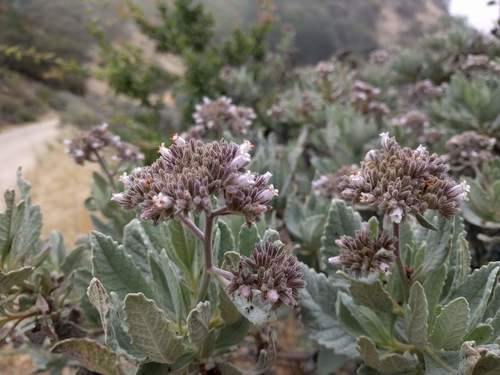
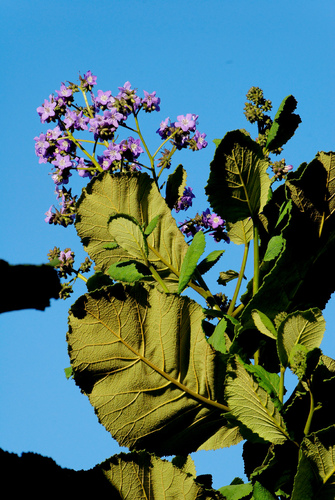
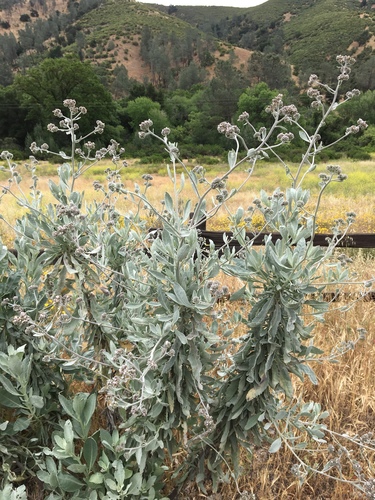
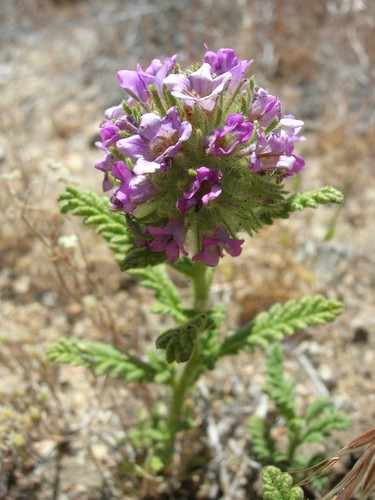
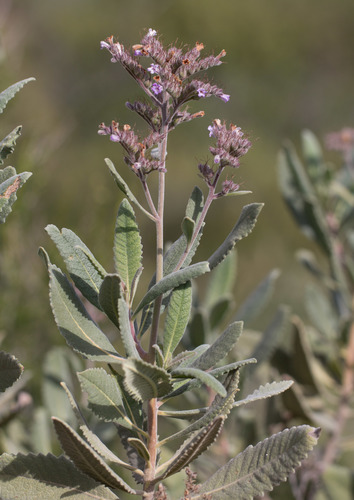
Eriodictyon crassifolium Benth. is a hairy to woolly shrub that reaches 1 to 3 meters in height. It has woody, branching stems. Its leaves can grow up to 17 centimeters long and 6 centimeters wide, are dark green, and sometimes have toothed edges. The underside of each leaf is hairy, while the upper surface is typically less hairy, harder, and leathery. Its inflorescence consists of a cluster of bell-shaped lavender flowers. This species can be easily confused with two other yerba santa species, Eriodictyon trichocalyx and Eriodictyon californicum. A more serious risk of confusion exists with the toxic Eriodictyon parryi, commonly called poodle-dog bush. E. parryi grows in the same types of environments as E. crassifolium, though it usually occurs in disturbed landscapes like burn areas, and it is an extremely potent skin irritant. Details for distinguishing between these species are provided in the article on E. parryi. Eriodictyon crassifolium is native to California and Baja California. It grows in several habitat types including chaparral, found in coastal and inland hills and mountains. It occurs mainly in Southern California, south of the latitude of the Santa Barbara/San Luis Obispo county line, extending from the coast inland through the Coast Ranges and Transverse Ranges. In northern Baja California, it is found in the area around La Misión. This plant grows mostly on dry slopes and in washes, is commonly found along roadsides, and may also grow on mesas or in river bottoms. It can grow via crown sprouting in disturbed areas. In the Transverse Ranges, it grows at elevations up to 2500 meters (8000 feet), though it is more common below 1800 meters (6000 feet). Individuals growing at lower elevations may reach up to 2 meters tall and have dense vegetation. The Chumash people traditionally used this plant to keep airways open for proper breathing. Its leaves can be chewed like gum or brewed into a bitter tea, though some people find the plant's odor unpleasant. When collecting leaves of this species for human consumption, it is critical to accurately distinguish it from the toxic E. parryi.