About Eriocrania semipurpurella Stephens, 1835
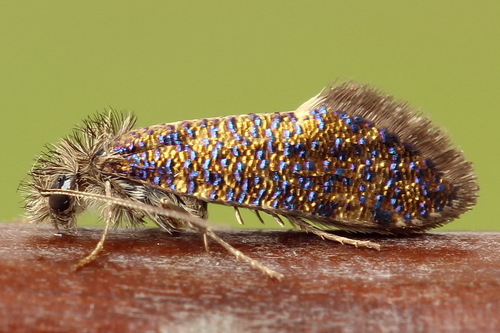
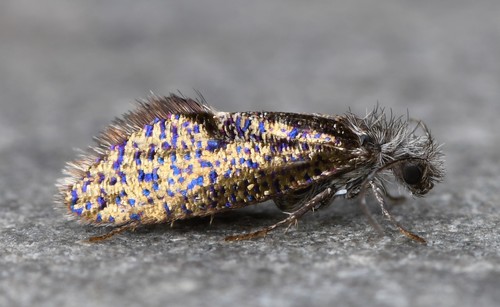
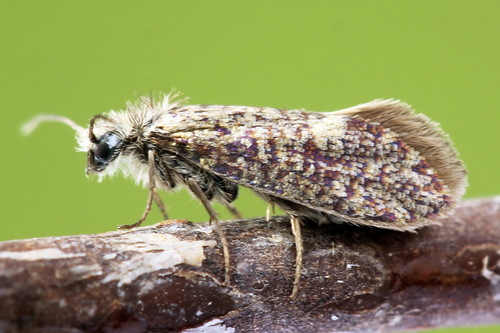
This species, Eriocrania semipurpurella, has a wingspan of 10–16 mm. Edward Meyrick provided the following description: The forewings are elongated, colored bronzy-purple, and more or less sprinkled with pale shining golden. There is an indistinct, usually small transverse pale golden dorsal spot before the tornus, which is sometimes almost entirely absent. Cilia are bronzy-grey, and become ochreous-whitish at the dorsal spot; vein 9 is absent. Hindwings have hairscales except towards the posterior margins, and are bronzy-grey with a purplish tinge on the posterior portion. Full-grown larvae are whitish, with a pale ochreous-brown head and darker mouthparts, and develop in leaf blotches on birch. Adult moths fly from March to April, depending on location. They fly in sunshine around birch trees (Betula species), sometimes occurring in swarms during these months, and rest on twigs during dull weather. Eriocrania semipurpurella looks very similar to E. sangii, and can only be distinguished from this species by microscopic examination of the genitalia. Eggs are laid on leaf buds. Larvae feed inside leaf mines from the end of March to early May. The mine starts at or near the edge of a leaf, and widens into a blotch. The frass produced by the larvae is string-like. Young larvae have dark markings on the head and prothorax, which lighten as the larva matures. Pupation occurs inside a tough silken cocoon in the soil.