About Eriocnemis vestita (R.Lesson, 1839)
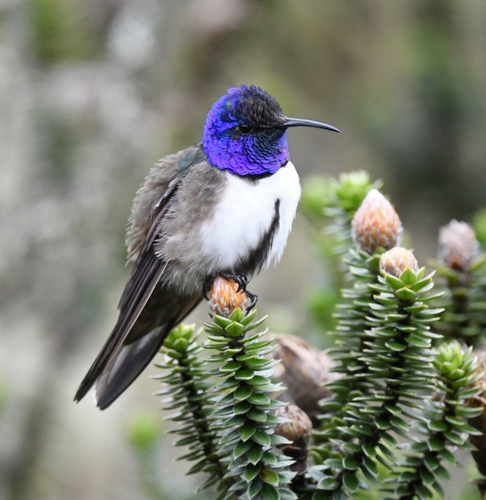
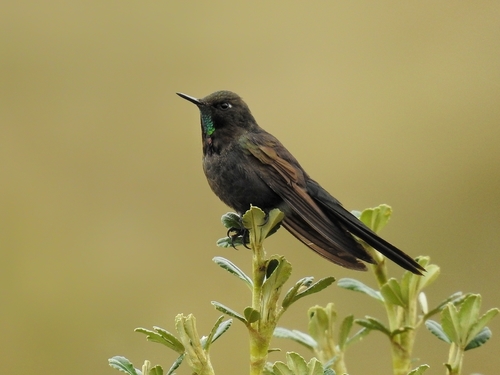
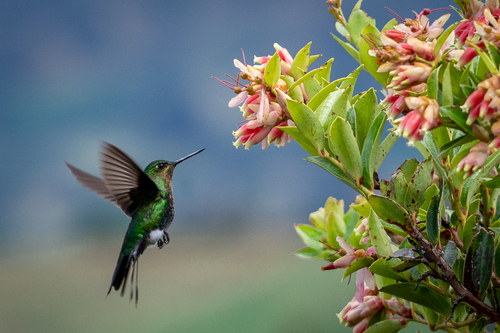
Eriocnemis vestita, commonly known as the glowing puffleg, measures 9 to 10 cm (3.5 to 3.9 in) in total length. Males weigh 3.3 to 7.2 g (0.12 to 0.25 oz), while females weigh 3.6 to 5.3 g (0.13 to 0.19 oz). The species has a straight, blackish bill. For the nominate subspecies, mature males have shining dark green upperparts, with golden green coloring on the rump and uppertail coverts. They have a glittering purple throat patch, thinly bordered by golden green. The remaining throat area and upper breast are shining blackish green, the belly is glittering golden green, and the undertail coverts are iridescent purplish blue. The characteristic leg puffs are white, and the forked tail is dark steel blue. Females of the nominate subspecies have shining golden green upperparts. Their throat patch consists of a small number of bluish purple feathers set against a buffy background. The rest of the throat and the breast are buff, and the belly is grayish white; all of these areas have golden green feathers scattered across them. Juvenile glowing pufflegs are similar in appearance to adult females. The four recognized subspecies differ in pattern and markings: Subspecies E. v. paramillo matches the nominate subspecies, but lacks the golden green fringe surrounding the purple throat patch. Males of E. v. smaragdinipectus have the largest purple throat patch of all subspecies. E. v. arcosae is similar to E. v. smaragdinipectus, but its rump and uppertail coverts are yellowish green, and this coloring extends up into the lower back. Males of this subspecies also have shorter bills and a grayer belly than nominate subspecies males. Each subspecies has a distinct geographic range in the Andes mountains. E. v. paramillo is found in the northern sections of Colombia's Western and Central Andes, mostly within Antioquia Department. E. v. vestita (the nominate subspecies) ranges from Mérida state in northwestern Venezuela into the Eastern and Central Andes of Colombia, reaching as far south as Cundinamarca and Huila departments. E. v. smaragdinipectus occurs from the Central Andes of southern Colombia in Cauca Department, south to Cañar Province in Ecuador. E. v. arcosae is found in the Andes from Azuay Province in southern Ecuador into the extreme northern Peruvian departments of Piura and Cajamarca. The glowing puffleg inhabits a variety of fairly open landscapes, where cloudforest edges and elfin forest are the most common habitat types. It also lives on brushy slopes, in overgrown pastures, and in páramo, and occurs occasionally in denser subtropical forest. Its overall elevational range is 2,300 to 4,200 m (7,500 to 13,800 ft), though most individuals are found between 2,800 and 3,500 m (9,200 and 11,500 ft).