About Eriocnemis luciani (Bourcier, 1847)
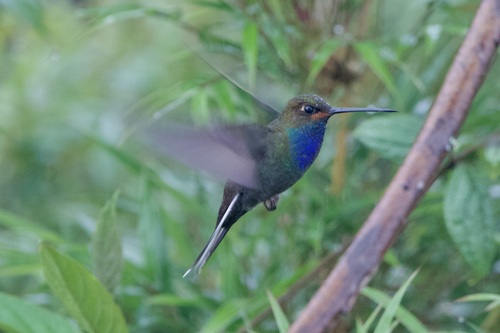
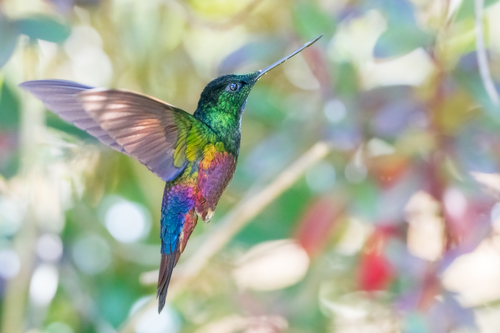
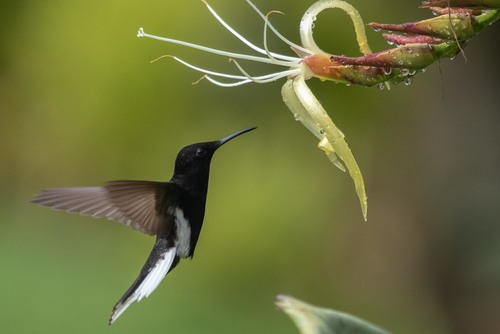
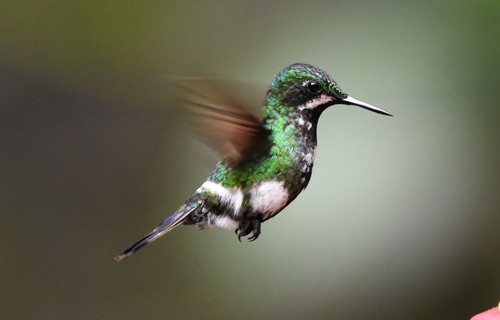
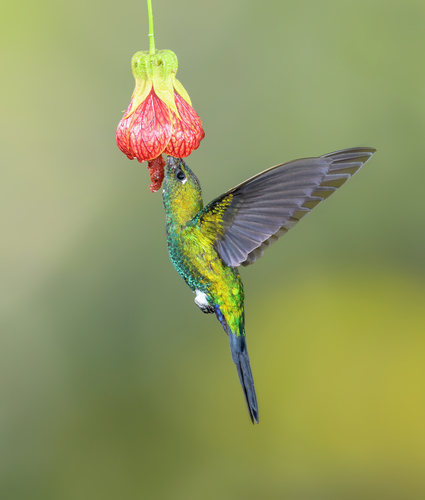
The sapphire-vented puffleg (scientific name Eriocnemis luciani, first described by Bourcier in 1847) measures 11.4 to 14 cm (4.5 to 5.5 in) in length and weighs 5.4 to 6.4 g (0.19 to 0.23 oz). It has a straight black bill. For the nominate subspecies, the male has metallic grass green upperparts and a shining dark blue forecrown. Most of its underparts are glittering golden green, with a glittering purple vent and undertail coverts. It has white leg puffs, and a deeply forked blue-black tail. The female is slightly smaller than the male and has a less deeply forked tail, but has identical plumage to the male. Several other subspecies differ in coloration from the nominate: E. l. meridae is a more bronzy green than the nominate, with an emerald to golden chin and iridescent copper fringes on much of its head feathering. E. l. baptistae is an even deeper bronzy green than E. l. meridae. E. l. catharina has upperparts matching the nominate, but lacks the blue forecrown; the male of this subspecies has a bluer belly, and the center of the female's belly is whitish. E. l. sapphiropygia is a lighter green than the nominate, also lacks the nominate's blue forecrown, and has a bronzy or coppery tinge on the rear of its crown. The subspecies of sapphire-vented puffleg have the following recorded distributions, with taxonomic notes as outlined below. E. l. meridae is recorded from Paramo Conejos in Mérida state, western Venezuela. E. l. luciani (the nominate) is found in the Andes from Nariño Department in southwestern Colombia, south through western Ecuador into Cotopaxi Province. E. l. baptistae occurs in the Andes of central Ecuador, from Chimborazo Province to Azuay Province. E. l. catharina is found in the Utcubamba River valley of the eastern Andes in northern Peru. E. l. sapphiropygia occurs in the eastern Andes of central and southern Peru, from the Department of La Libertad to the Department of Puno. Because E. l. meridae is only known from a single 19th century specimen and may be extinct, the South American Classification Committee (SACC) does not include Venezuela in the species' full range. The SACC also notes that the species has only a hypothetical record in Bolivia, with no tangible evidence supporting its presence there. There are several unexplained gaps in the species' distribution along the Andes. The sapphire-vented puffleg lives in humid montane forest, especially elfin forest and Polylepis woodlands, and also occurs in brushy páramo. In Ecuador, it lives at elevations between 2,700 and 3,700 m (8,900 and 12,100 ft), and is found mostly below 3,400 m (11,200 ft). In Peru, it occurs at elevations between 2,400 and 3,500 m (7,900 and 11,500 ft).