About Eriochilus dilatatus Lindl.
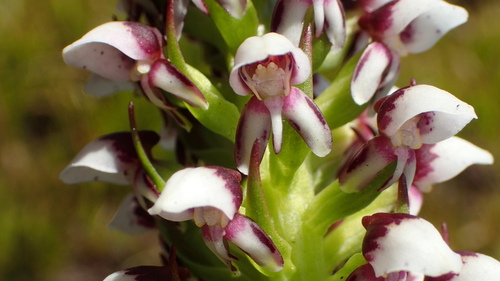
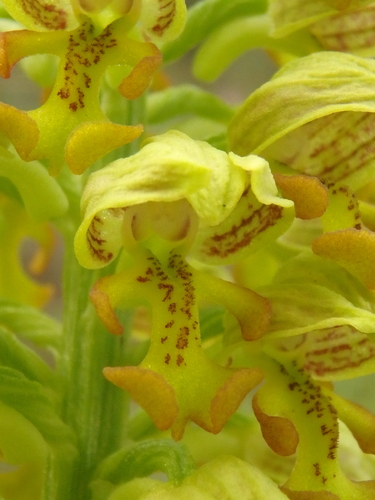
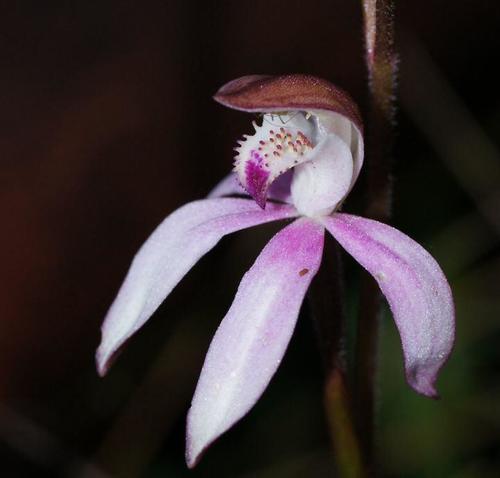
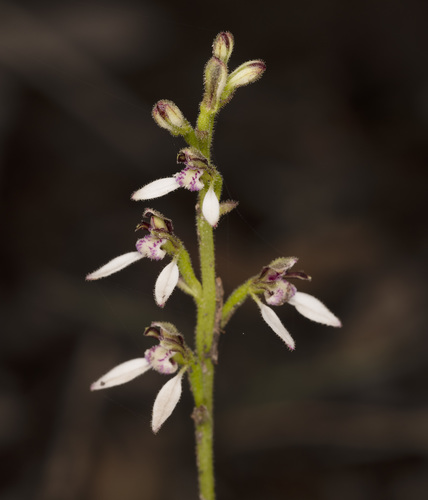
Eriochilus dilatatus is a terrestrial, perennial, deciduous herb that grows from an underground tuber. Flowering individuals produce a single egg-shaped leaf, measuring 15–75 mm long and 5–15 mm wide, that attaches roughly halfway up the flowering stem. Non-flowering plants usually produce a larger leaf that grows on a stalk 60–150 mm tall. The flowering stem stands 100–350 mm tall and bears up to fifteen flowers, most often more than three. Each individual flower is white and greenish, measuring 12–18 mm long and 10–12 mm wide. The dorsal sepal is spatula-shaped, 5–10 mm long and 2–4 mm wide. Lateral sepals are white or cream-coloured, 7–20 mm long and 2.5–4 mm wide. Petals are greenish with brownish-red stripes, 5–8 mm long, around 1 mm wide, and held more or less upright. The labellum is greenish cream, 6–11 mm long and 3–5 mm wide, covered in clusters of cream-coloured to pale purple hairs, and curves prominently downwards. Flowering occurs between March and June, and some subspecies flower more prolifically after fire. Eriochilus dilatatus was first formally described in 1840 by John Lindley, with the description published in A Sketch of the Vegetation of the Swan River Colony. The specific epithet dilatatus is a Latin word meaning "spread out", "enlarged", or "extended", referring to the species' broad labellum and lateral sepals. Six subspecies are currently recognized: E. dilatatus subsp. dilatatus grows in shrubland and woodland in near-coastal areas between Dirk Hartog Island and Israelite Bay; E. dilatatus subsp. brevifolius grows in shrubland between Cataby and the Murchison River; E. dilatatus subsp. magnus grows in high rainfall areas between Perth and Albany; E. dilatatus subsp. multiflorus is found in woodland and forest between Jurien Bay and Albany; E. dilatatus subsp. orientalis is only found near Caiguna; E. dilatatus subsp. undulatus is the most widespread subspecies, growing in a range of habitats between Mullewa and Esperance. All bunny orchid species are pollinated by small native bees, which are attracted to nectar produced at the base of the labellum. In horticulture, Eriochilus species are generally easy to grow in pots kept in a bushhouse or cool glasshouse. They require regular watering during their growing season, but must be kept dry while dormant over summer.