About Eriocheir sinensis H.Milne Edwards, 1853
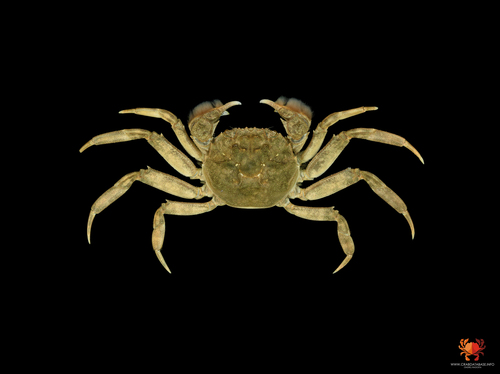
Eriocheir sinensis, the Chinese mitten crab, can be recognized by the dense patches of dark setae, or "fur", on its claws. Its body is roughly the size of a human palm, with legs approximately twice as long as its 3 to 10 centimeter (1 to 4 inch) wide carapace.
In its native range, this crab originates from Hong Kong north to the border of Korea. While it can be found inland, it prefers coastal habitats. It has been recorded up to 1,400 kilometers (760 nautical miles) upstream in the Yangtze, the largest river within its native range. It commonly settles in coastal rice fields and inland rivers, and occurs in both subtropical and temperate regions.
Chinese mitten crabs are catadromous: they spend most of their life in fresh water and return to the sea to breed. Their overall lifespan ranges from one to five years depending on location, with aquaculture farms in China reporting maturity reached between one and three years, while invasive crabs in colder European climates take four to five years. In some cases, individuals can live up to 7 years, or even 8 years in Germany, as they spawn at the end of their lifespan and perish after the breeding cycle. Spawning crabs average around 5.5 centimeters (2 1/4 inches) in length.
When sexual maturity approaches in late August, the crabs leave their freshwater feeding grounds and begin migrating downstream toward the sea. It is during this downstream migration that the crabs reach puberty and develop their sex organs. Breeding takes place in brackish water starting in late fall. Males arrive first and overwinter in the brackish water, while females arrive later. Eggs are laid within 24 hours of mating, and are attached to the female's abdomen. After attaching the eggs, the female immediately moves toward the river mouth to overwinter in deeper waters. In spring, the female returns to brackish water to hatch her eggs. Eggs require full salt water to fully mature.
After hatching, larvae float and drift in brackish waters. The final larval stage is the megalopa, which measures 3 to 4 millimeters (1/8 to 5/32 of an inch) in length. Juvenile crabs then gradually move upstream into fresh water to mature, completing the life cycle. Because of the long breeding migration, Chinese mitten crabs only breed once in their lifetime, at the end of their lifespan. They produce a large number of eggs to compensate for single lifetime breeding, and they waste away and die after successful reproduction.