About Eriocampa ovata (Linnaeus, 1760)
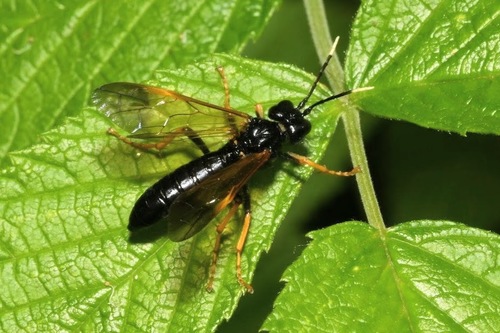
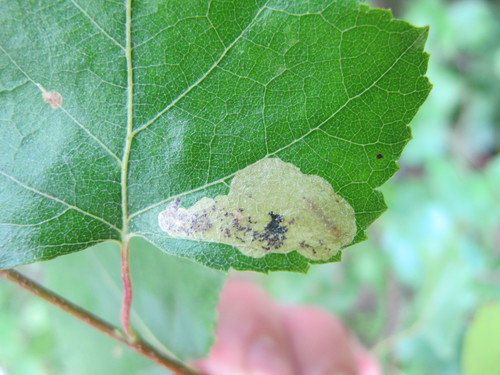
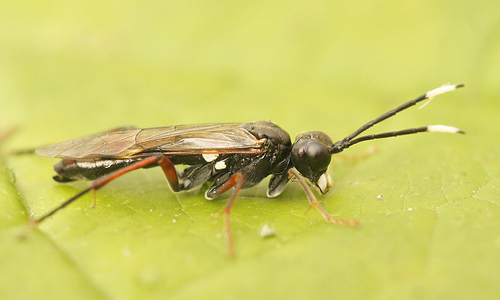
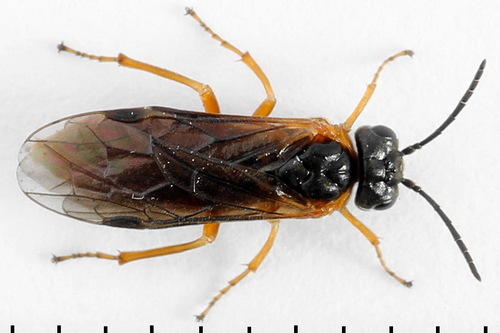
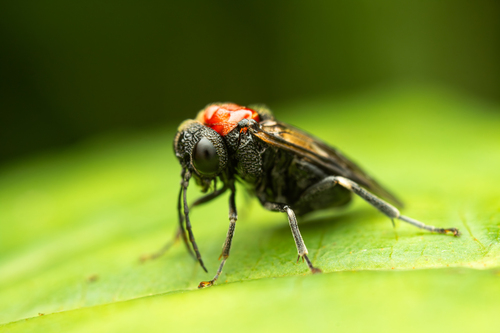
Eriocampa ovata (Linnaeus, 1760), commonly known as the alder sawfly, has the following physical description. Adult females are approximately 7 mm (0.3 in) long, and are primarily black. The first two segments of the thorax are red, while the underside of the antennae tips, the inner side of the fore-tibia, and the basal part of the hind femur are whitish. The head has many large puncture marks, the thorax has scattered smaller puncture marks, and the abdomen has faint transverse sculpturing. Wings are translucent with black veins. Adult males are unknown in North America, and rare in Europe; females of this species reproduce via parthenogenesis. Larvae reach a length of 5 to 7.5 mm (0.2 to 0.3 in). They are white, except for a brown marking on the head, and are covered in a glossy white woolly secretion created by epidermal glands. This sawfly is native to Europe, and was accidentally introduced to North America, where it has become established on both the Atlantic and Pacific coasts. It has spread to New York, Massachusetts, Quebec, Ontario, Washington, British Columbia, and Alaska. Its main host trees are common alder (Alnus glutinosa) and grey alder (Alnus incana); in Europe, it has also been recorded feeding on elm (Ulmus) and hazel (Corylus). Regarding its life cycle, adult females use their ovipositor to insert eggs into the upper surface of a leaf near the midrib. When larvae hatch, they first feed on the upper leaf surface, then move to feed on the underside. Once fully developed, larvae drop to the ground and form a cocoon in leaf litter, where they pupate and overwinter. There are two generations per year in Quebec, while England has only one generation per year. Females lay eggs on young foliage located near the base of the host tree, and the upper crown of the tree is usually left unaffected. Heavy feeding can skeletonize leaves, leaving only veins intact, which reduces tree growth; stressed trees may become more susceptible to alder canker.