About Erinaceus europaeus Linnaeus, 1758
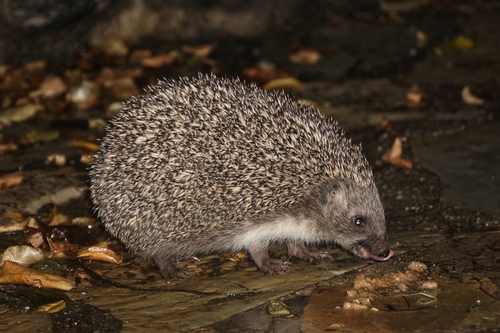
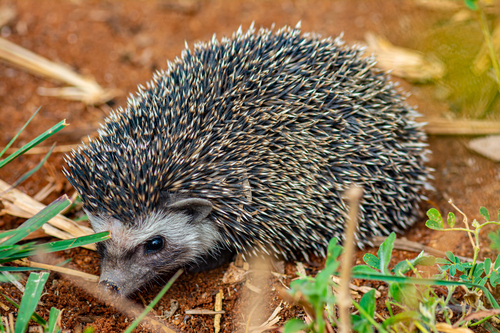
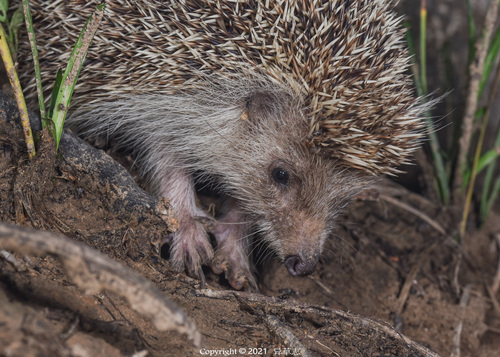
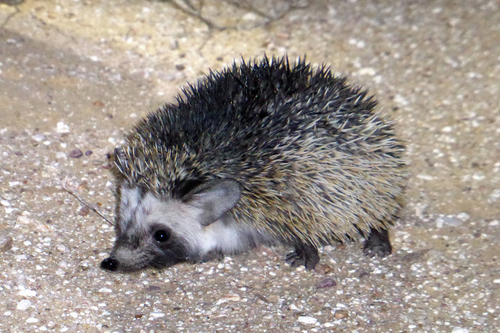
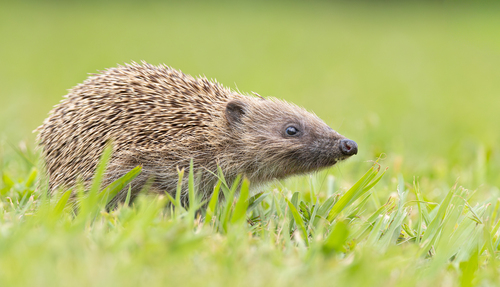
The European hedgehog (Erinaceus europaeus Linnaeus, 1758) has a generalized body structure with unspecialized limb girdles. Its overall color is brownish, and most of its body is covered in up to 6000 brown and white spines. At weaning, head-and-body length is approximately 160 mm (6 in), growing to 260 mm (10 in) or longer in large adults. It has an extremely short, almost vestigial tail that typically measures 20 to 30 mm (0.8 to 1.2 in). Body weight ranges from around 120 g (4 oz) at weaning to over 1100 g (40 oz) in adulthood. The maximum recorded weight is 2000 g (70 oz), though few wild specimens exceed 1600 g (55 oz) even in autumn. Adult summer weight is typically lower than autumn weight, averaging around 800 g (28 oz), and adult weights commonly drop as low as 500 g (18 oz). Males are usually slightly larger than females, but seasonal weight variation is much larger than any difference between sexes. Across most of its range, no other species resembles the European hedgehog. When it lives alongside the northern white-breasted hedgehog (Erinaceus roumanicus), the two are hard to tell apart in the field; the northern white-breasted hedgehog can be distinguished by a white spot on its chest. The European hedgehog is likely the largest hedgehog species, and may be the heaviest member of the order Erinaceomorpha.
The European hedgehog is native to Europe, where its range extends from Ireland and the Iberian Peninsula east through most of western to central Europe, and from southern Fennoscandia and the northern Baltic to north-west Russia. It also occurs on Mediterranean islands including Corsica, Sardinia, Elba, Sicily, most French Atlantic islands, and Irish and British islands, where it is both native and introduced. It is an invasive exotic species in New Zealand, and it has been suggested that it may also have been introduced to Ireland and many of the smaller islands where it lives.
Between the 1860s and 1890s, colonists brought European hedgehogs from England and Scotland to New Zealand on sailing ships, mostly to use as biological control for agricultural pests or as pets. Few survived the roughly 50–100 day voyage, but all surviving hedgehogs lost their fleas during the trip. The founding population first established itself in the South Island, and spread was aided by guards releasing hedgehogs at country railway stations. Hedgehogs were introduced to the North Island in the 1890s, and some were also moved from the South Island between 1906 and 1911; after this point, their population grew exponentially. By the 1920s, they had become so common that game-bird hunters blamed them for smaller hunting catches. Hedgehogs were declared noxious animals, and regional authorities offered a bounty of one shilling per hedgehog snout for several years. By the 1950s, hedgehogs were found across nearly all of New Zealand, only absent from the coldest, wettest part of the South Island and alpine areas with permanent snow. Even so, hedgehogs have been observed climbing New Zealand glaciers. Hedgehogs in New Zealand do not reach the same weights as their counterparts in colder parts of Europe. Due to New Zealand's milder winters, local hedgehogs only hibernate for three months a year, so they do not need to gain as much autumn weight as European populations. In northern New Zealand, many hedgehogs do not hibernate at all. Around 50% of modern New Zealand hedgehogs have faulty teeth, a trait that traces back to one of the founding individuals. Most New Zealanders welcome hedgehogs in their gardens because the hedgehogs eat slugs and snails. Conservationists have concerns, however, because hedgehogs compete with native bush birds for invertebrate prey and eat rare insects, lizards, and ground-nesting birds. As a result, large-scale hedgehog control programs are run in parts of New Zealand, killing thousands of hedgehogs annually. Roadkill counts show that North Island hedgehog populations peaked in the 1950s; since then, roadkill numbers have dropped dramatically from around 50 per 100 km to fewer than 1 per 100 km.
The European hedgehog occupies a very wide range of habitat types, including both semi-natural vegetation and areas heavily modified by human activity. Its habitat includes woodland, grasslands like meadows and pasture, arable land, orchards, vineyards, and the mixed habitats found in human settlements. It prefers lowlands and hills up to 600 m in elevation, but also occurs locally in mountains, and can exceptionally be found as high as 2000 m (for example in the Alps and Pyrenees). Outside of cultivated land, it prefers forest edge areas, especially ecotonal grass and scrub vegetation. Hedgehogs are most abundant in gardens, parks, and amenity land near or within human settlements. They are generally uncommon in marshes and moorland, likely because these areas lack suitable sites and materials for building winter hibernation nests, which have specific requirements. In Finland, European hedgehogs especially use pine tree roots for winter nests.
The European hedgehog is mostly nocturnal. It walks hesitantly, and stops frequently to sniff the air. Unlike smaller hedgehog species from warmer climates, the European hedgehog may hibernate during winter. Even so, most hibernating individuals wake at least once to move to a new nest.