About Erinaceus amurensis Schrenk, 1859
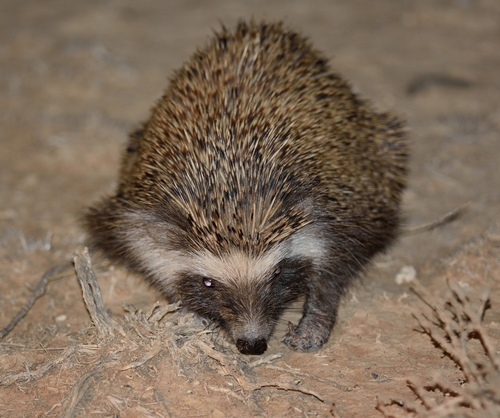
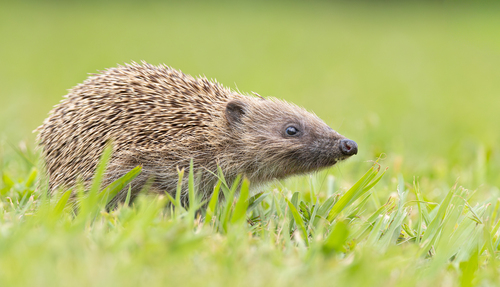
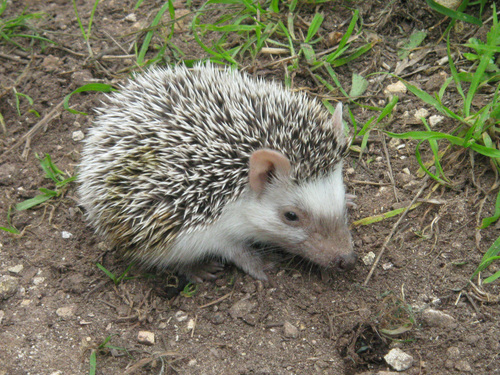
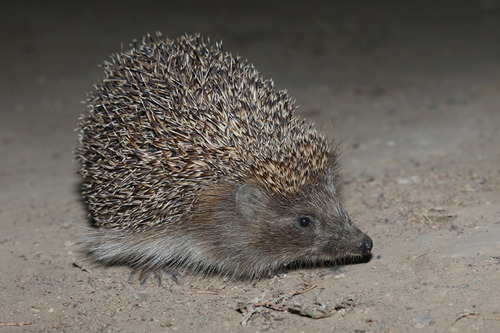
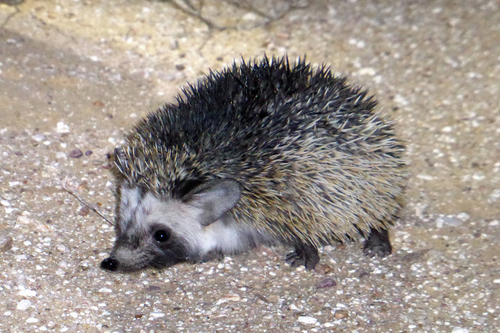
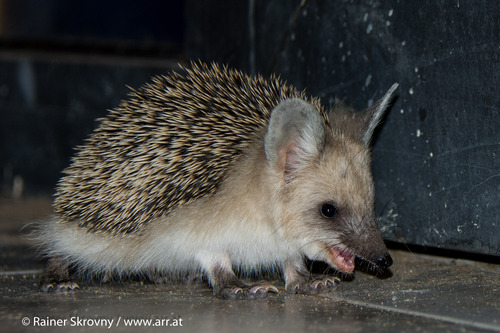
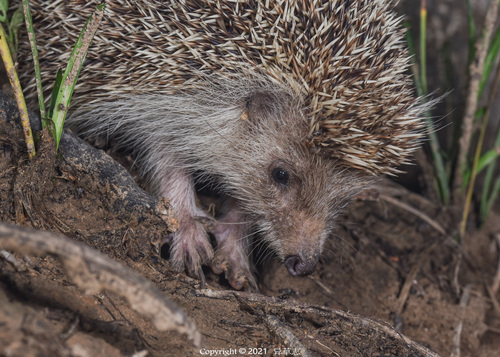
The Amur hedgehog (Erinaceus amurensis Schrenk, 1859) is closely related to the European hedgehog, and is slightly larger and lighter in color. Its head-and-body length ranges between 160 and 290 mm (6 and 11 in), it has a very short tail, and it weighs between 600 and 1,000 g (21 and 35 oz). Its head, back, and sides are covered with long, sharp spines. The spines come in two different color patterns: some are entirely plain white, while others have a white or yellowish-brown base and tip, with a mid to dark brown central portion. This coloration gives the hedgehog an overall pale, brownish-grey appearance. Narrow strips of bare skin separate the quills on the hedgehog's head. These quills are made of keratin, and are strong enough to avoid breaking or falling out. When threatened, the spines act as a defense mechanism: the hedgehog curls into a ball, with quills facing outward and its face and head curled inward. Pale hair covers the hedgehog's face and underparts.
The Amur hedgehog is native to Amur Oblast and Primorye (Russia), Manchuria (China), and the Korean Peninsula. Its native range extends from approximately 29°N, just south of the Yangtze River, northward to the Amur Basin and the Korean Peninsula. It has also been introduced to Kanagawa and Shizuoka Prefectures in Japan. There are conflicting reports about the habitats it occupies. The IUCN Red List notes that it occurs in valleys and lowlands, and is not found in highland regions or cultivated fields. *The Mammals of China* disagrees, stating that suitable habitats for the species include montane and sub-alpine terrain, steppe, shrublands, cultivated land, villages, and city parks. It is generally accepted to occupy a wide range of other habitats including grassland, forest edges, and areas of mixed coniferous and broadleaf woodland.
Amur hedgehogs are solitary and typically only meet during the mating season. As of yet, there is no confirmed species-specific information about this hedgehog's reproduction, although other sources note it produces one or two litters in summer, each with four to six young.
Like other hedgehogs, the Amur hedgehog is nocturnal. It emerges at night to forage for small arthropods (especially fly larvae), as well as earthworms, centipedes, snails, mice, frogs, and occasionally fruit. Chinese sources record sable (Martes zibellina) as a predator of this species, but Russian sources dispute this claim. Around October each year, the Amur hedgehog enters torpor and hibernates until spring.