About Erimystax x-punctatus (Hubbs & Crowe, 1956)
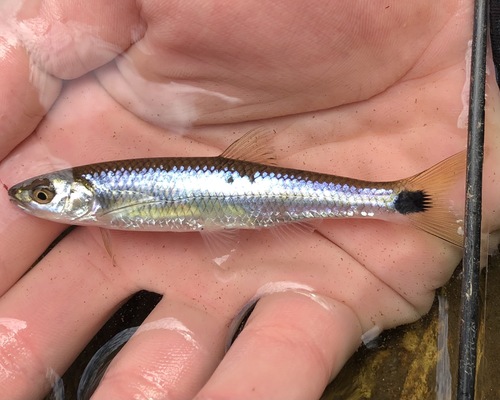
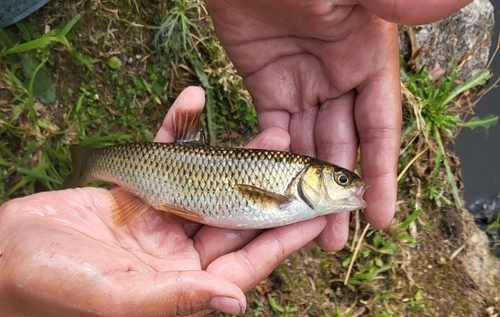
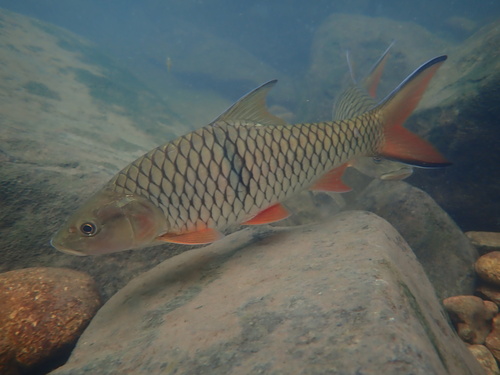
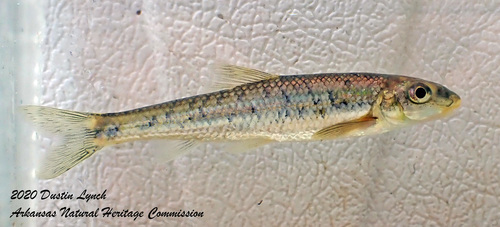
The gravel chub, scientifically named Erimystax x-punctatus (Hubbs & Crowe, 1956), is a medium-sized minnow usually smaller than 10 cm. It has a slender body that is silver overall, with an olive tint on the back and a white tint on the underside, plus a crosshatch pattern across all its scales. Gravel chubs are often misidentified as the closely related streamline chub, but can be distinguished by their more defined crosshatch markings and lack of dark blotches along the lateral line, which runs straight from the anterior to posterior end of the fish. Other defining features of the gravel chub include a subterminal jaw with barbels extending from both the upper and lower maxillary jaw bone. Its outer covering is made of small, bony-ridged cycloid scales, with 40 to 43 of these scales running along the lateral line, and it has a forked homocercal tail. Gravel chubs are soft ray-finned fish with no adipose fin. Their pectoral fins are pointed, made up of approximately 13 to 16 rays, and located relatively low on the body, which is typical of primitive fish species. The pelvic fins are rounded, made up of eight rays, and located further back, posterior to the dorsal fin in an abdominal position. The caudal fin is moderately forked and pointed. Gravel chubs are mainly found in the northeastern parts of North America, and their overall distribution across the continent is spotty, ranging from south-central Arkansas to southern Minnesota and eastward to western New York. There were historical reports of populations in Ontario's Thames River, but none have been found there since 1958, and 1970s and 1980s studies of the Thames River confirmed this absence. Across its range, the species only occurs in specific bodies of water in most states. In New York, it is found only in the Allegheny River drainage; in Minnesota, it is limited to two Mississippi River drainage rivers, the Root River and the Upper Iowa River; in Wisconsin, it is confined to the lower Rock River, including the lower Pecatonica River, lower Sugar River and the main channel. Gravel chubs inhabit select small rivers and medium to large creeks and streams. They are commonly found gathered in slightly turbulent water areas called riffles. In the summer, they can be found in water around 18 °C to 25 °C. They prefer long flat areas on river and stream beds, and can also be found at the tail of rapids and the head of pools, where riffles are most common. They prefer bottoms with fine limestone gravel and other pea-sized rocks. Gravel chubs are only found in clear, clean water and are intolerant to excess silt and debris. They are more often found in areas with limited macrophytes, larger rooted aquatic plants, algae and moss. Because they require this specialized clean habitat, the gravel chub is especially vulnerable to various forms of pollution, particularly from agricultural practices that cause erosion and excessive silt buildup. Past sampling surveys found gravel chubs as far north on the Upper Iowa River as Le Roy, Minnesota, but excessive sewage, pesticides and sedimentation of rocks and sand have eliminated the species from this area. The presence of gravel chubs in a body of water is an indication of good local water quality. Little is known about the biological life cycle of the gravel chub. Studies of populations in Kansas indicate that spawning occurs in early spring, while surveys of Minnesota waters indicate spawning starting in May and continuing into June. Adult gravel chubs have been observed spawning while gathering on gravel bars in soft currents formed by a water level rise after heavy rains.