About Erignathus barbatus (Erxleben, 1777)
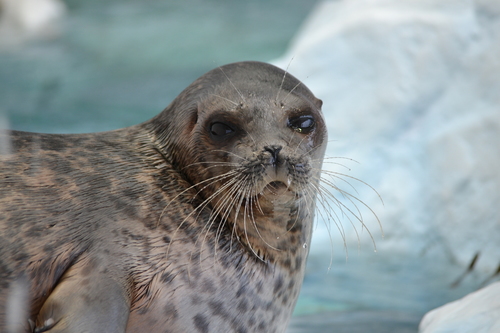
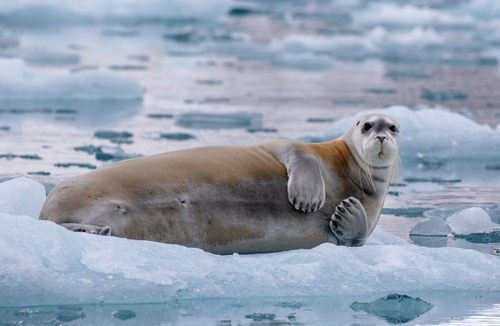
This earless seal species, the bearded seal (Erignathus barbatus), can be identified by its square fore flippers and thick bristles on its muzzle. Adult bearded seals are greyish-brown, darker on the back, and rarely have a small number of faint spots on the back or dark spots on the sides. Their face and neck are occasionally reddish brown. Newly born bearded seal pups have a greyish-brown natal coat with scattered white patches on their back and head. Within the subfamily Phocinae, the bearded seal is unique in having two pairs of teats, a trait it shares with monk seals. Adult bearded seals measure 2.1 to 2.7 m (6.9 to 8.9 ft) from nose to tail, and weigh between 200 and 430 kg (441 to 948 lb). Females are larger than males, and adult body fat content ranges from approximately 25 to 40%. Bearded seals currently live in Arctic and Subarctic regions. In the Pacific, their range stretches from the Arctic's Chukchi Sea south into the Bering Sea, covering the area from Bristol Bay on the Alaskan coast to the Sea of Okhotsk on the Russian coast, reaching the northern coast of Japan but not including it. In the Arctic Ocean, they occur along the northern coasts of Russia, Norway, Canada, and Alaska, including the Norwegian Svalbard archipelago and the Canadian Arctic Archipelago. In the Atlantic, bearded seals are found along the northern coast of Iceland, the east and west coasts of Greenland, and the Canadian mainland as far south as Labrador. While their typical range only extends as far south as Subarctic areas, individual bearded seals have been observed in Japan and China, and far outside their normal range as far south as Germany, the Netherlands, the United Kingdom, France, Spain, and Portugal. In Arctic ecosystems, bearded seals and ringed seals are both major food sources for polar bears. Polar bears most often attack bearded seal pups up to around 2 years of age, frequently targeting newborns inside their birthing lairs, and older juvenile and adult bearded seals are commonly left unharmed. Killer whales also prey on bearded seals, and sometimes overturn ice floes to reach the seals resting on them. Walruses may occasionally eat bearded seals, mainly targeting pups, though this type of predation is rare. Bearded seals give birth to their young in the spring. In the Canadian Arctic, pups are born in May. In Svalbard, bearded seals reach sexual maturity at 5 or 6 years of age. Further south in Alaska, most pups are born in late April. Pups are born on small drifting ice floes in shallow waters, and usually weigh 30–40 kg (66–88 lb) at birth. Pups enter the water just hours after being born, and quickly become skilled divers. Mothers care for their pups for 18 to 24 days, during which pups grow at an average rate of 3.3 kg (7.3 lb) per day. Pups consume an average of 8 L (1.8 imperial gallons; 2.1 US gallons) of milk each day while nursing. By the time they are weaned, pups reach a weight of approximately 100 kg (220 lb). A new mating cycle occurs just before pups are weaned. Female bearded seals ovulate at the end of their lactation period, but stay near their pups and are ready to defend them if needed. During the mating season, male bearded seals "sing" by emitting a long, drawn-out warbling note that ends in a moan or sigh. This vocalization may attract females, or it may be used by males to mark their territory or signal that they are ready to breed. Males return to and occupy the same areas year after year. Like many Arctic mammals, bearded seals use a reproductive strategy called delayed implantation. After fertilization, the blastocyst does not implant into the uterus for two months, and implantation most often occurs in July. This means the total gestation period for bearded seals is around eleven months, while the active gestation period is nine months. Bearded seals are thought to live up to 31 years.