About Erigeron strigosus Muhl. ex Willd.
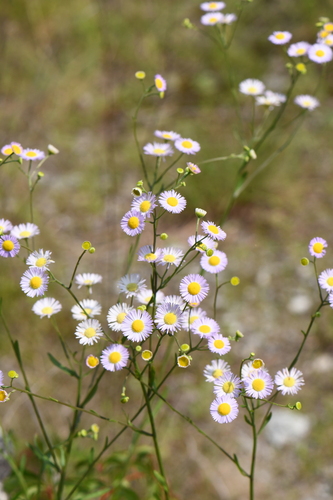
Erigeron strigosus Muhl. ex Willd. is a flowering plant species in the family Asteraceae, with three common names: prairie fleabane, common eastern fleabane, and daisy fleabane. This species is native to eastern and central North America, ranging west as far as Manitoba, Idaho, and Texas. It has become naturalized in western North America, Europe, and China, where it occurs as a somewhat weedy naturalized species. Erigeron strigosus is an annual or biennial herb that grows up to 80 cm (32 inches) tall. Its oval-shaped leaves are hairy, petioled, and non-clasping, measuring a few centimeters long, and grow mostly on the lower portion of the plant. A single plant can produce up to 200 flower heads arranged in a spindly array of branching stems. Each flower head is less than 1 centimeter (0.4 inches) wide, holding 50 to 100 white, pink, or blue ray florets that surround a center of numerous yellow disc florets. Four varieties of this species have been recorded. Erigeron strigosus var. calcicola J. R. Allison occurs in Alabama, Georgia, and Tennessee. Erigeron strigosus var. dolomiticola J. R. Allison is found in Alabama. Erigeron strigosus var. strigosus ranges across much of North America, and is introduced in China. Erigeron strigosus var. septentrionalis (Fernald & Wiegand) Fernald grows across much of North America, and is introduced in Europe. Erigeron strigosus var. calcicola is located in the central basin of Tennessee, northwest Georgia, northern Alabama, and southwest and central Kentucky, where it grows in limestone glades. Erigeron strigosus var. dolomiticola is endemic to Bibb County, Alabama, and grows in calcareous glades. E. strigosus var. strigosus is widely distributed in North America, and occurs in disturbed sites including roadsides, as well as open woodlands. E. strigosus var. septentrionalis is also found across most of North America, growing on roadsides and in other disturbed areas. In part of its native range, Erigeron strigosus grows in tall grass prairie, an ecosystem where fire is a regular natural occurrence. A fire cycle initially causes a reduction in Erigeron strigosus populations, but populations increase two to three years after fire occurs. This species often germinates in response to fire disturbance, and its germination rates are higher when fire disturbance occurs than when it does not. Fire cycles also reduce the occurrence of infections on Erigeron strigosus, such as infection from the rust fungus Puccinia dioicae. Overall, increasing fire frequency has a positive effect on E. strigosus populations.