About Erigeron canadensis L.
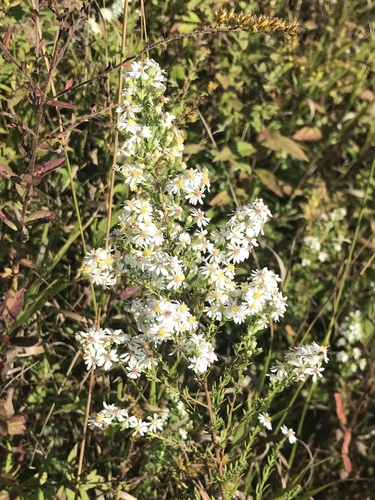
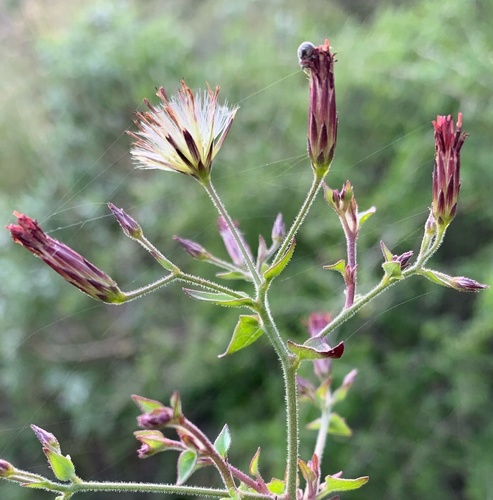
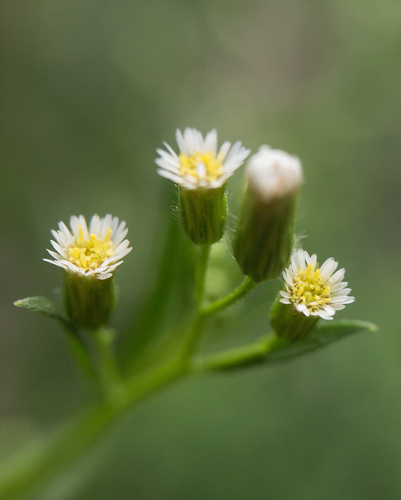
Erigeron canadensis (common name horseweed) is an annual herbaceous plant. It grows up to 1.5 metres (5 feet) tall, with sparsely hairy stems. Its unstalked, slender leaves are 2–10 centimetres (0.8–3.9 inches) long and up to 1 cm (0.4 in) wide, with coarsely toothed margins. Leaves grow in an alternate spiral arrangement along the stem, and lower leaves wither early. Flower heads form dense inflorescences, and each head is 1 cm (0.4 in) in diameter. Every flower head has a ring of white or pale purple ray florets surrounding a centre of yellow disc florets. Its fruit is a cypsela tipped with dirty white down. Erigeron canadensis can easily be confused with two related species: Erigeron sumatrensis, which may grow to 2 m (6.6 ft) tall, and the more hairy Erigeron bonariensis, which does not exceed 1 m (3.3 ft). E. canadensis is distinguished by its bracts, which have a brownish inner surface with no red dot at the tip, and are nearly or completely free of the hairs found on the bracts of the other two species. Horseweed originated in North America and Central America, and is widespread in its native range. It has spread to inhabited areas across most of the temperate zone of Asia, Europe, and Australia. In Britain, it is found from northern Scotland to Cornwall, growing as a weed of arable land and man-made environments. It is considered invasive in China. Horseweed can grow in a range of habitats, from sand dunes to old fields, as well as in gardens and other disturbed areas. It is an indicator of disturbance because it often colonizes disturbed areas where it was sparse or absent before disturbance. It is a common pest of agricultural fields, and can tolerate soils from pH 4.8 (acidic) to 7.2 (neutral). Horseweed produces a large amount of seeds that are dispersed by wind, allowing it to easily colonize disturbed soils. The seeds can germinate at any time of year when there is sufficient moisture and proper temperatures. With fall germination, the plant overwinters as a rosette, bolts in spring, and flowers in summer. With spring germination, it spends less time as a rosette before bolting to flower. Seeds can persist in the seedbank at both disturbed and non-disturbed sites, though it is more prevalent in disturbed sites. Seeds can persist in the seedbank after a fire, and the plant increases in frequency in response to more frequent fire regimes. The Zuni people insert crushed flowers of E. canadensis var. canadensis into the nostrils to cause sneezing, relieving rhinitis. The Seminole people used it for cold and cough medicine, the Iroquois people used it to help combat fevers, and the Navajo and Chippewa peoples used it for stomach pain. Other medicinal applications include use as a nervine, stimulant, and antiplasmodic.