About Erigenia bulbosa (Michx.) Nutt.
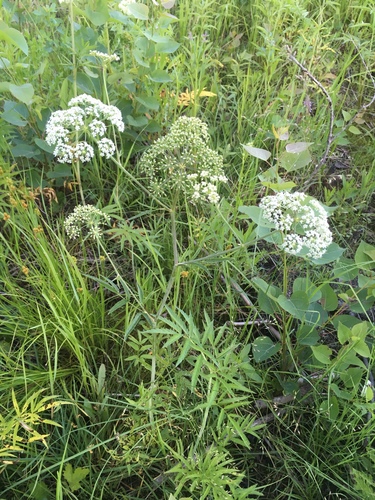
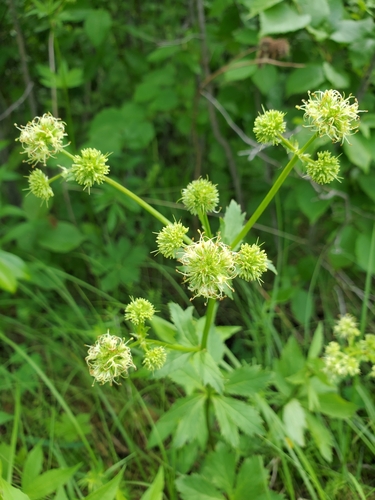
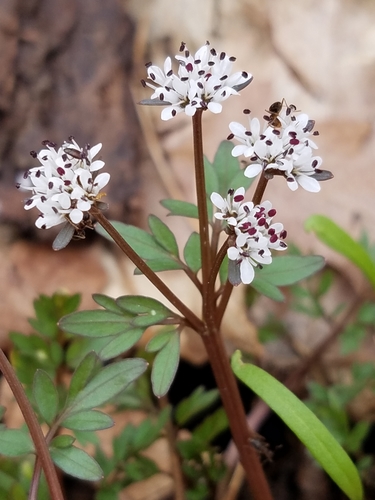
Erigenia bulbosa (Michx.) Nutt., commonly called harbinger of spring, is a small spring ephemeral. When flowering, it reaches only 5–15 cm tall, and grows slightly larger after flowering finishes. Each spherical bulb produces one purplish stem that ends in an umbel flower cluster. Its flowers have white, teardrop-shaped petals that are 3-4 millimeters long, widely spaced, and do not touch one another. The flowers also have large dark-reddish anthers. Like other members of the carrot family, its leaves have sheathed bases and are pinnately divided into many small sections.
This species occurs as an occasional plant in rich hardwood forests of eastern North America. Its range extends north to central New York and southern Wisconsin, west to the western Ozarks, and south to central Alabama. It is also found in extreme southern Ontario.
Its typical associated plant species are spring beauty (Claytonia virginica) and cut-leaf tooth wort (Cardamine laciniata). All of these early spring-blooming plants are pollinated primarily by solitary bees, and to a lesser extent by flies and honey bees. Each flower of E. bulbosa accumulates a small amount of nectar daily, equal to 7–38 μg of sugar per flower. However, the numerous, closely arranged, simultaneously blooming flowers in its umbel can increase the total nectar incentive for visiting pollinators. The nectar produced by this species only contains the sugar fructose. Unlike most plants, Erigenia bulbosa does not form vesicular-arbuscular mycorrhizal associations with fungi. It is protected as a state endangered plant in New York and Wisconsin.
The bulb of Erigenia bulbosa is edible eaten either cooked or raw. The Cherokee people used this plant in chewing form as medicine for toothaches, though it is unknown which part of the plant they chewed. It is sometimes grown in native wildflower gardens throughout its natural range.