About Erica cinerea L.
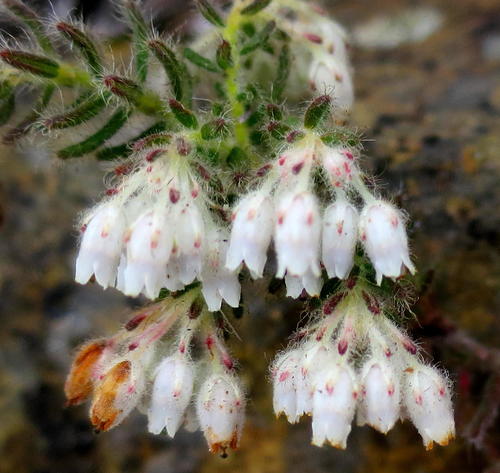
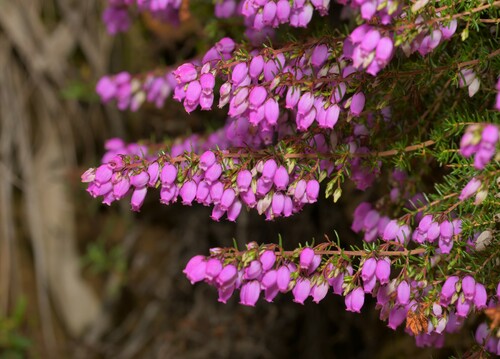
Erica cinerea L. is a low, spreading shrub that reaches 15–60 centimetres (6–23+1⁄2 inches) in height. It has fine, needle-like leaves 4–8 millimetres (1⁄8–3⁄8 in) long, arranged in whorls of three. Its flowers are bell-shaped, purple (rarely white), and 4–7 mm (1⁄8–1⁄4 in) long, produced from mid- to late summer. The flowers have a dry texture similar to that of strawflowers. Erica cinerea is native to western Europe, where it is most abundant in Britain and Ireland, France, northern Spain, and southern Norway. It also grows in the Faroe Islands, Belgium, Germany, north-western Italy, and the Netherlands. It occurs mostly on moors and heathland with relatively dry, acidic, nutrient-poor soils. It can also be found in coastal dune heath and dune slack, and occasionally in woodland. This plant produces large amounts of nectar for pollinators. In a UK plant survey conducted by the AgriLand project, which is supported by the UK Insect Pollinators Initiative, Erica cinerea ranked in the top 5 for highest nectar production, measured as nectar per unit cover per year. It is categorized as "of least concern" on the IUCN Red List of Threatened Species. Erica cinerea is grown as an ornamental plant, and cultivated varieties come in a wider range of colors. It is drought-tolerant, and grows well in full sun and well-drained soil. Like most heathers, it is a calcifuge and does not tolerate alkaline soils such as calcareous soils, which cause symptoms of iron deficiency in the plant. Like other cultivated heathers, it is often used as groundcover among plantings of dwarf conifers. Several of its cultivars have gained the Royal Horticultural Society's Award of Garden Merit: these are 'C.D. Eason', 'Pink Ice', 'Stephen Davis', and 'Velvet Night'. The cultivar 'Eden Valley' has lavender flowers that shade to white at the base of the corolla, and has a prostrate growth habit. The original 'Eden Valley' plant was found on Trink Hill, Cornwall, by Miss Gertrude Waterer. Bell heather is a source of heather honey.