About Erica arborea L.
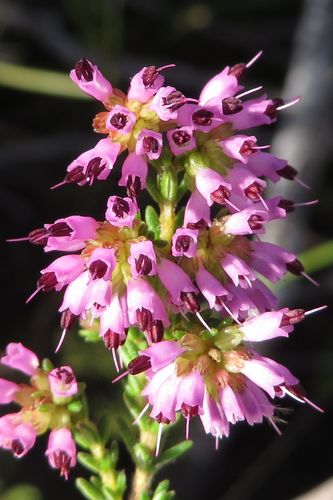
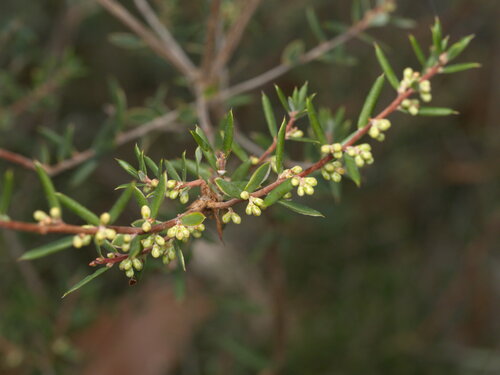
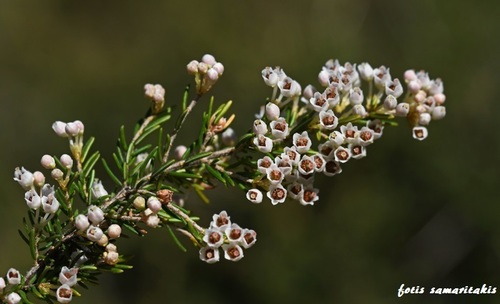
Erica arborea L. is an upright evergreen shrub or small tree. In the wild, especially in Africa, it typically reaches around 7 m (23 ft) tall, while garden-grown plants more commonly reach 1–4 m (3–13 ft). It produces dark green, needle-like leaves and many small, honey-scented, bell-shaped white flowers. It is a calcifuge, meaning it prefers acid soil in an open, sunny location.
This heather has a disjunct native distribution, covering both sides of the Mediterranean basin, western Caucasus, mountains of tropical eastern Africa, and the Arabian Peninsula. Its distribution across the Mediterranean Basin is not continuous, stretching from the Atlantic coasts of Portugal and Spain to the Black Sea coast of Turkey and Georgia. In the Mediterranean Basin, it grows in semi-arid Mediterranean maquis shrublands, and can also be found in forest understory up to 1400 m above sea level in cooler, more humid environments. It prefers acidic or acidified soils formed from siliceous substrates. There is also an isolated native population in the Tibesti Mountains of Chad, in the Sahara, where it grows at the top of upper montane desert steppe vegetation between 2500 and 3000 m above sea level.
In eastern Africa, this species is commonly called giant heather. It grows in the Ethiopian Highlands, and on the highest mountains along the East African Rift from southern Uganda to northern Malawi. It is also found in the Sarawat Mountains of the southwestern Arabian Peninsula, in Yemen and Saudi Arabia. In these African and Arabian mountain areas, it is part of tropical alpine vegetation, and dominates shrubland above the treeline at altitudes between 3,000 and 4,000 m. While it was previously thought to grow in Macaronesia, the similar species found there is now classified as a separate species, Erica canariensis.
Erica arborea has naturalised populations in Great Britain, southeastern Australia, and New Zealand, where it is considered a potential environmental weed. Its extremely hard, dense, heat-resistant wood is known as briar root. It is primarily used to make smoking pipes, as it does not alter the aroma of tobacco. Football-sized tubers are harvested when the plant is 30 to 60 years old; they are cooked for several hours, then dried for several months before further processing. The wood is also used to make jewellery, fountain pens, and knife handles.