About Eretmochelys imbricata (Linnaeus, 1766)
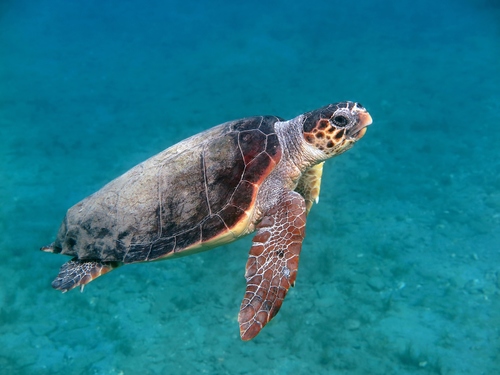
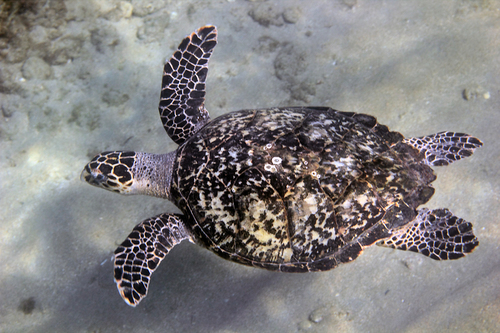
Adult hawksbill sea turtles (Eretmochelys imbricata) typically reach 1 meter (3 feet) in length and weigh an average of around 80 kilograms (180 pounds). The heaviest hawksbill ever recorded weighed 127 kilograms (280 pounds). The species' shell, called a carapace, has an amber background marked by an irregular pattern of light and dark streaks, with mostly black and mottled brown colors that radiate out toward the sides of the shell.
Several features set hawksbill sea turtles apart from other sea turtle species. Their elongated, tapered head ends in a beak-like mouth, which is where the common name "hawksbill" comes from; this beak is more sharply hooked and pronounced than the beaks of other sea turtle species. Each of the hawksbill's forelimb flippers has two visible claws. A particularly easy-to-identify characteristic is the pattern of thick scutes that form the hawksbill's carapace. Like several other members of its sea turtle family, the hawksbill has five central scutes and four pairs of lateral scutes on its carapace, but the posterior scutes of E. imbricata overlap in a way that gives the rear margin of the carapace a serrated, saw-like appearance, similar to the edge of a saw or steak knife. The carapace of a hawksbill can grow to almost 1 meter (3 feet) in length. Hawksbills often use their sturdy shell to wedge their bodies into tight spaces in coral reefs.
When crawling on sand, hawksbills use an alternating gait that leaves asymmetrical tracks. This differs from the more symmetrical gait of green sea turtles and leatherback sea turtles. Because hawksbills eat venomous cnidarians, their flesh can be toxic. The hawksbill is biofluorescent, and it is the first reptile ever recorded to have this trait. It remains unknown whether this biofluorescence comes from the hawksbill's diet, which includes biofluorescent organisms such as the hard coral Physogyra lichtensteini. Male hawksbills have more intense pigmentation than females, and researchers have speculated that these differences may play a behavioral role.
Hawksbill sea turtles have a wide distribution, and are found mostly on tropical reefs in the Indian, Pacific, and Atlantic Oceans. Of all sea turtle species, E. imbricata is the most strongly associated with warm tropical waters. Two major distinct subpopulations are recognized, one in the Atlantic Ocean and one in the Indo-Pacific.
Adult hawksbill sea turtles live primarily in tropical coral reefs. During the day, they are most commonly found resting in caves and ledges on and around these reefs. As a highly migratory species, they occupy a broad range of habitats, from the open ocean to lagoons and even mangrove swamps in estuaries. Little research exists on the habitat preferences of young, early life-stage E. imbricata. Like other young sea turtles, they are assumed to be fully pelagic, staying out at sea until they reach maturity. Early life-stage hawksbills have been observed seeking out habitats where they can camouflage or hide to reduce the chance of being detected by predators.