About Eremopterix nigriceps (Gould, 1839)
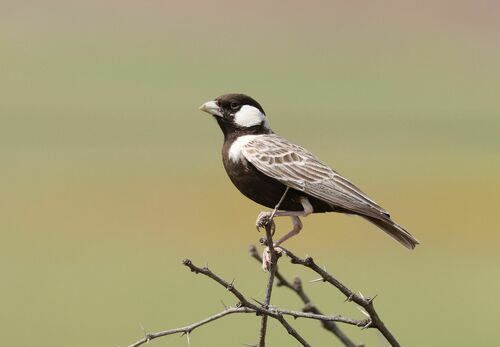
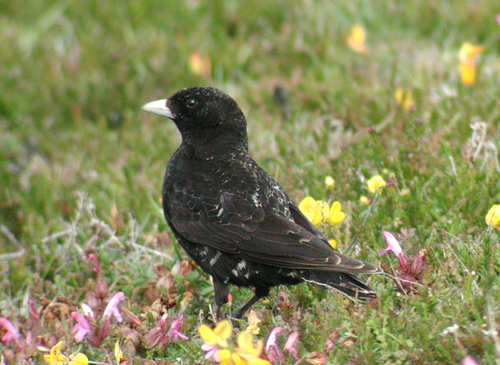
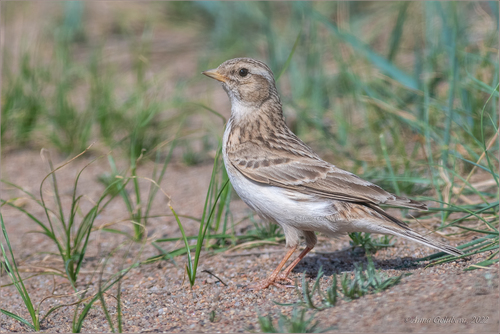
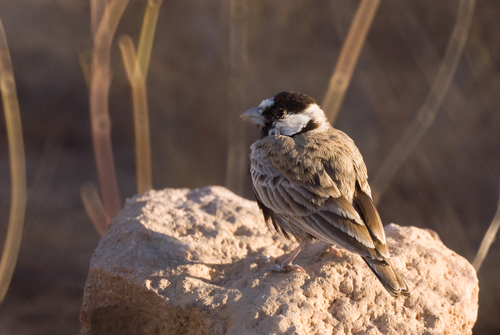
This species has the scientific name Eremopterix nigriceps (Gould, 1839), and measures 11.5–12.5 cm in total length from bill to tail. Adult males have a bold contrasting black-and-white head pattern: the head is mostly black, with distinct white forehead and white cheek patches. Their upperparts are pale greyish brown, underparts and underwings are black, and these contrast with a white patch on the sides of the breast. The tail is blackish with buff edges and grey central feathers, and the bill is horn coloured. Females differ noticeably from males: their upperparts are pale sandy brown with faint streaking on the crown, and they have whitish patches around the eye and on the sides of the neck. The female's underparts are whitish, with a pale cinnamon breast band and black underwing coverts. Juveniles are similar to females, but the feathers on their head are tipped with buff. The male's song is quite variable, and typically consists of a short series of simple, sweet notes. Males sing either during flight displays or from a low vantage point on a bush or rock. The black-crowned sparrow-lark occurs across North Africa, ranging from the Cape Verde archipelago east through the northern African Sahel, across the Arabian Peninsula, and into Pakistan and India. It inhabits arid and semi-arid plains with scattered low vegetation and grass tussocks, preferring sandy areas over rocky soil, and has also been observed around salt pans. To reduce water loss during the heat of midday, these birds stay in shade, and have even been recorded sheltering inside the burrows of large lizards. They regulate their body temperature by flying with legs dangling below their body to expose bare skin, or by perching facing into the wind with drooped wings to increase the surface area exposed to moving air. Outside the breeding season, black-crowned sparrow-larks may form foraging flocks of up to 50 birds, though large flocks of several thousand individuals have been recorded. The black-crowned sparrow-lark primarily eats seeds, but also feeds on insects and other invertebrates. Nestling young are fed mostly an insect diet while in the nest. Due to the hot environment they inhabit, the birds do most of their foraging during early morning and evening. They normally find food on the ground, but will sometimes hawk and catch flying insects in the air.