About Eremopterix griseus (Scopoli, 1786)
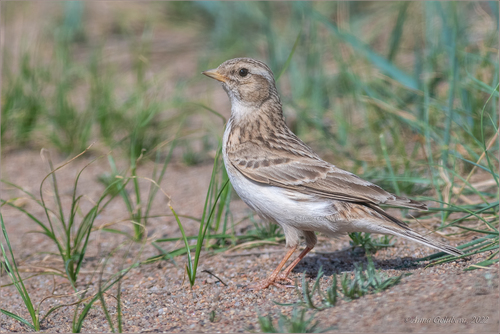
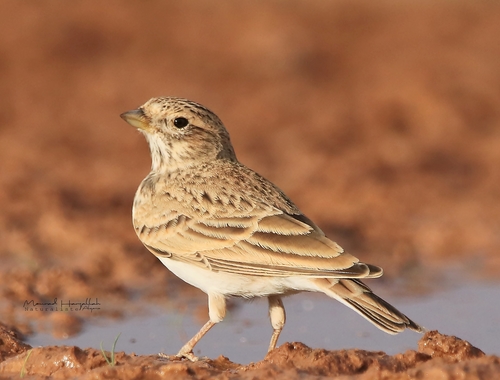
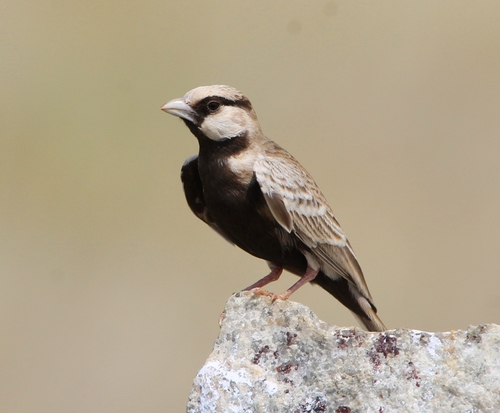
These birds are sparrow-sized, with a finch-like bill and short legs. They are most often seen sitting on the ground, and while they will sometimes perch on wires, they never perch in trees or bushes. The male is sandy brown across most of its body, with a black belly, chin, lower lores, and eye stripe. The top of its head is ashy, though the base of these crown feathers is dark. This differs from the black-crowned sparrow-lark, which has dark brown to black crowns, and whose range partly overlaps with this species in the arid zone of India and Pakistan. The female is pale brown, and very similar to a female house sparrow, though she has much shorter legs, a stockier build, and a shorter neck. This species is restricted to elevations below 1,000 m (3,300 ft). Its range extends from south of the Himalayas to Sri Lanka, reaching the Indus River system in the west and Assam in the east. It inhabits stubble, scrub, waste land, riverside sand, and coastal tidal flats, and avoids the interior of the desert zone, a habitat more commonly used by the black-crowned sparrow-lark. While the two species have partly overlapping ranges, they are rarely found together in the same location. During the monsoon season, this species leaves regions with heavy rainfall. These larks occur in pairs or small groups, and form larger flocks in winter. They forage on the ground for seeds and insects, and will also eat fallen grain in fields. When disturbed, they sometimes crouch before taking flight. They roost overnight on the ground, creating small depressions in the soil to rest in. Breeding is irregular and spread out, and mostly occurs before the rains: breeding falls mainly between February and September in southern India, and between May and June in Sri Lanka. Males perform a display song flight: they soar upwards while giving chirruping calls, then dive with partly closed wings before rising in a glide. This undulating flight is paired with a long low whistle on each dive, and a sharp chilp note at the highest point of each rise. The display ends when the male descends at an angle and lands on a small mound or clod, and he will repeat the performance after a few minutes. The nest is a compact depression in the ground, positioned under a tuft of grass, lined with grass and hair, with pebbles arranged along its edge. The typical clutch is two or three eggs, and both males and females incubate the eggs. Eggs hatch after approximately 13 or 14 days, and both parents take turns feeding the young, though the female is more active in feeding. In most birds of this species, the right ovary is not fully developed; one study found that 6 out of 150 examined specimens had traces of a right ovary, though none had a corresponding oviduct.