About Eremophila sturtii R.Br.
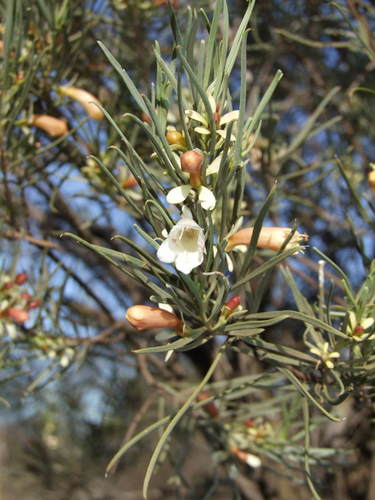
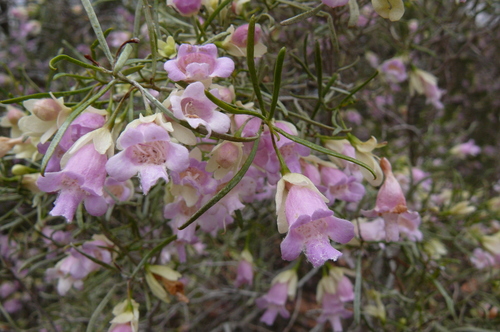
Eremophila sturtii R.Br. is a shrub that grows 1 to 3 meters (3 to 10 feet) tall, with many slender branches and dark grey, deeply fissured bark on older plants. Its leaves are arranged alternately, are bright green, slightly aromatic, most measuring 10 to 50 millimeters (0.4 to 2 inches) long and 0.5 to 2.5 millimeters (0.02 to 0.1 inches) wide. The leaves are linear in shape with a curved, hooked tip, are hairless, shiny, and often sticky from produced resin. Flowers are borne singly, rarely in pairs, on 6 to 18 millimeter (0.2 to 0.7 inch) long curved stalks in leaf axils. There are 5 cream-coloured to pinkish-purple sepals that are lance-shaped to egg-shaped. The sepals are sticky, mostly hairless, and usually 7 to 11 millimeters (0.3 to 0.4 inches) long. The five petals are 12 to 18 millimeters (0.5 to 0.7 inches) long, joined at the lower end to form a bell-shaped tube. The petal tube ranges in color from lilac to mauve or pinkish purple, is rarely white, and has purple spots. The outside of the petal tube has glandular hairs, while the outer surfaces of the petal lobes are often covered with many long, thin hairs. The inner surfaces of the lobes are hairless, except the lower lobe, which is covered with long thin hairs. The inside of the petal tube is filled with long, soft hairs. The 4 stamens do not extend beyond the end of the petal tube. Flowering occurs between July and October, followed by the development of hard, hairy, oval-shaped fruit that is 3.5 to 5 millimeters (0.1 to 0.2 inches) long. Eremophila sturtii is common and widespread across south west Queensland, western New South Wales, and eastern South Australia. A small population exists in the far north-west of Victoria. It also has a disjunct distribution in south-central Northern Territory, eastern Western Australia, and north central South Australia. It grows on clay plains, red sandy sand plains, and low shaley hills. Like its close relative E. mitchellii, E. sturtii is considered a weed in some pastoral areas. It can produce root suckers that allow it to form extensive colonies. If above-ground plant parts are removed, it regrows vigorously from its roots, and it is difficult to control with fire or herbicides. Legislation limiting land clearing exempts E. sturtii, E. mitchellii, and some other native species. Initial research into controlling the spread of E. sturtii focused on regeneration after severe 1974 fires in the Ivanhoe district of New South Wales. Results showed that E. sturtii is especially good at regenerating after fire, and that recovery seemed independent of burning conditions and shrub size. Later studies of grubbing techniques in the Cobar region of New South Wales found that ripping plants out of the soil and then covering exposed roots with soil is the most effective control method. Concerns have been raised about the consequences of removing this woody weed: as a stable dominant species in its environment, what replaces it after removal remains unclear. A native scale insect from the genus Pulvinaria has been found useful for controlling E. sturtii and E. mitchellii, but manual transfer of the insects is required for this method to be effective. Aboriginal Australians used munyunpa, this plant, as an infusion or in ash form to treat backache. They prepared an infusion or decoction from the leaves to treat sores, cuts, head colds, sore eyes, or diarrhoea. There is evidence that this plant was used to treat coughs and colds by grinding leaves, mixing with fat, and spreading the mixture on the skin. Recent research has focused on the pharmacology of many eremophila species, including E. sturtii. Isolating compounds from endemic plant species is becoming more common in the search for treatments against antibiotic resistant bacteria, a costly and time-consuming process. Research on E. sturtii has focused on developing an antibacterial layer that can be applied to medical implants to prevent infection. Eremophila sturtii has insect-repellent properties, and European settlers sometimes used its branches to thatch meat-houses. Aboriginal people used the plant to make weapons and implements, for shade and shelter, as fish poison, and to construct fish traps. They also ate its fruits.