About Eremophila polyclada (F.Muell.) F.Muell.
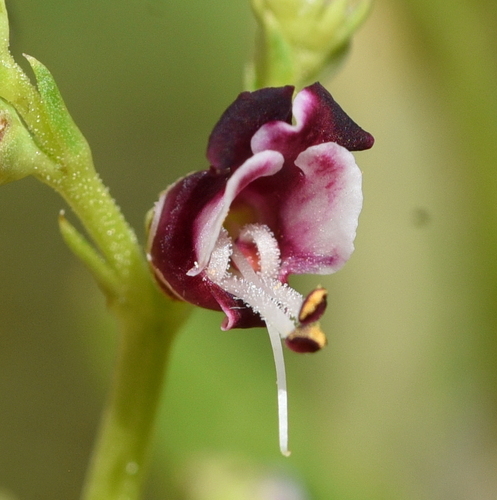
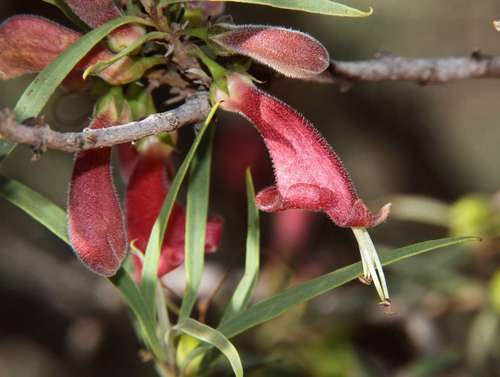
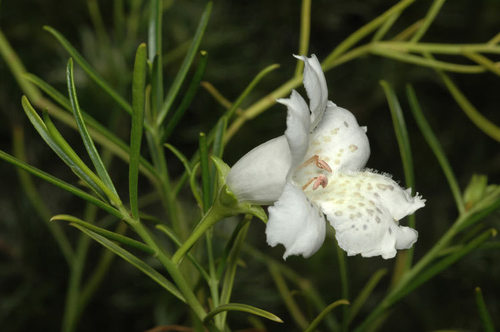
Eremophila polyclada (F.Muell.) F.Muell. is a dense, spreading shrub that grows to 1–3 metres (3–10 feet) in height and 1–5 metres (3–20 feet) in width. Its branches diverge at roughly 90° angles to one another, are stiff, and often end in a spine. Leaves are arranged alternately along the branches, are linear in shape, and mostly measure 20–40 mm (0.8–2 in) long and 1–3 mm (0.04–0.1 in) wide. Young leaves are often sticky due to the presence of resin. Flowers are borne singly or in pairs in leaf axils, on a stalk 1–2.5 mm (0.04–0.1 in) long. There are 5 green, overlapping sepals that are egg-shaped, with a prominent keel and thin, wing-like edges, and mostly measure 4.5–7 mm (0.2–0.3 in) long. The petals are 20–35 mm (0.8–1 in) long, joined at their bases to form a tube. The petal tube is white to very pale whitish-lilac, with faint blackish to green-purple spots on the inside of the lobes, and purple spots inside the tube. The tube and petal lobes are hairless except for the middle part of the lowest lobe and the inside of the tube, which are hairy. The 4 stamens are fully enclosed within the tube. Flowering occurs between October and May, and is followed by oval-shaped, cone-shaped or elliptical fruits with a pointed tip, which measure 8.5–13 mm (0.3–0.5 in) long.
This species is widespread in New South Wales west of Lightning Ridge and in southern Queensland. It also occurs in a small number of locations along the Murray River in Victoria and South Australia, with one recorded occurrence at Tarlton Downs in the Northern Territory. It grows in sandy to clay loam soils, most often on floodplains and other low-lying areas.
Commonly called twiggy emu-bush, this species is an ornamental shrub well-known in horticulture, with some specimens cultivated for over 35 years. It flowers profusely in summer, producing masses of white flowers when most other shrubs are dormant, and its dense, tangled branches make it a useful screening plant. Propagation is easiest from cuttings, which root within a few weeks in warm weather; its arching branches sometimes develop roots naturally when they touch the ground. It is a very drought tolerant shrub, only requiring watering once or twice during a long drought, and a deep watering early in summer can sometimes stimulate mass flowering. It is also tolerant of frost and can be pruned, preferably in early autumn. A hybrid between this species and E. divaricata, called Eremophila 'Summertime Blue', is popular in American gardens.