About Eremophila gilesii F.Muell.
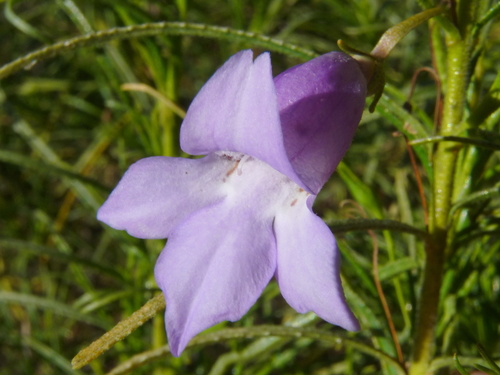
Eremophila gilesii F.Muell. is most often a low, spreading shrub, but it sometimes grows prostrate, and sometimes as an erect shrub. It typically reaches a height between 0.15 and 0.8 metres (0.5 to 3 feet). Its branches and leaves are sticky from naturally occurring resin. Leaves are arranged alternately along the stems, measuring 12–91 mm (0.5–4 in) long and 0.5–5.6 mm (0.02–0.2 in) wide. They are linear to lance-shaped, covered in glandular hairs, and their margins are sometimes serrated or bear fine teeth. Flowers usually grow singly in leaf axils, on an S-shaped, sticky, flattened stalk that is 6.5–32 mm (0.3–1 in) long. There are 5 green, linear to lance-shaped, tapering sepals that are 5.5–16 mm (0.2–0.6 in) long, and mostly covered with glandular hairs. Petals are 16.5–40 mm (0.6–2 in) long, joined at the lower end to form a tube. The outside of the petal tube ranges in colour from white to lilac, while the inside of the tube is white with purple spots. The outside of the tube and petal lobes are hairy; the inside of the lobes is glabrous, and the inside of the tube is woolly. All 4 stamens are fully enclosed within the petal tube. Flowering occurs from March to November, and is followed by dry, woody, oval-shaped, hairy fruits that are 6.5–12.5 mm (0.3–0.5 in) long. For distribution and habitat, Eremophila gilesii subsp. gilesii occurs in the Wanaaring and Enngonia districts of north-western New South Wales. It is widespread across the western half of South Australia, the southern half of the Northern Territory, and a central band across Western Australia, growing in sand or loam soils on plains and low hills. Subspecies variabilis is only found in Western Australia, in the Gascoyne, Gibson Desert, Great Victoria Desert, Little Sandy Desert and Murchison biogeographic regions, growing in sand, clay or laterite on plains or in rocky areas. In ecology, Eremophila gilesii regenerates rapidly after mulga clearing, so it is considered an agricultural weed in areas such as south-western Queensland. It produces large amounts of seed, and can easily form dense stands of up to 12,000 shrubs per hectare (5,000 per acre), which restricts pasture growth. Biological control using the grasshoppers Monistria discrepans and M. pustulifera has been trialled, as has management via heavy stocking after rainfall over 40 mm (2 in) in affected areas. More recent studies found that mechanical treatments like ploughing and heavy stocking may not reduce the total number of plants, but instead reduce their size, which makes moving livestock easier. For Indigenous use, Aboriginal people use this eremophila in multiple ways, including as a decoction and infusion, to treat ailments such as headache, chest pains, sores and colds.