About Eremophila freelingii F.Muell.
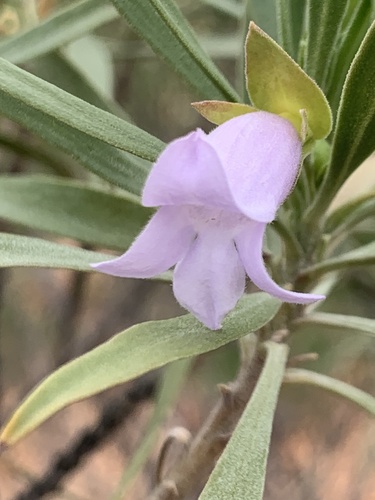
Eremophila freelingii is a small to medium shrub that typically grows 0.8 to 2 meters (3 to 7 feet) in both height and width. Its branches are covered in white hairs, and have a rough texture caused by raised leaf bases. Leaf size varies based on the plant's location, but most leaves are elliptic to lance-shaped, measuring 35–80 mm (1–3 in) long and 5–10 mm (0.2–0.4 in) wide. Leaves are shiny and sticky from resin, and have sparse to dense hair coverage; the resin can sometimes hide the hairs. Flowers grow singly or in groups of up to three in leaf axils, on a stalk that is 8–40 mm (0.3–2 in) long. There are 5 shiny, sticky sepals that are either green or purple, and differ from each other in size and shape, ranging from egg-shaped to narrow lance-shaped, and 10–19 mm (0.4–0.7 in) long. Petals are 20–32 mm (0.8–1 in) long, and are joined at their lower end to form a tube. The petal tube is pale to dark lilac, and covered with hairs on the outside, including on the outer surface of the petal lobes. The inner surface of the lobes is hairless (glabrous), but the inside of the tube is filled with woolly hairs. All 4 stamens are fully enclosed inside the petal tube. Flowering can occur year-round, but is most common between August and November. After flowering, the plant produces dry, woody, oval-shaped fruits that are 6–9 mm (0.2–0.4 in) long. Eremophila freelingii grows in clay soils in rocky areas, found in the North-western, Lake Eyre, Gairdner-Torrens, Flinders Ranges and Eastern botanical regions of South Australia. In New South Wales, it occurs north of the Tibooburra-Milparinka area, growing in rocky areas alongside mulga. It can also be found in the south of the Northern Territory and far south-west Queensland, most often on rocky hills or stony flats. Common name Limestone fuchsia, this species was called a range of names by different Aboriginal Australian communities, including arrethe, and was used medicinally to treat scabies and skin lesions.