About Eremophila forrestii F.Muell.
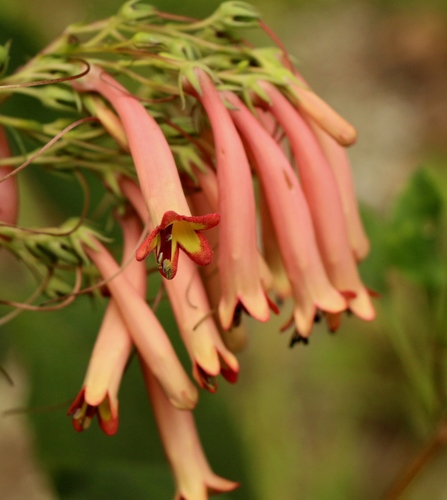
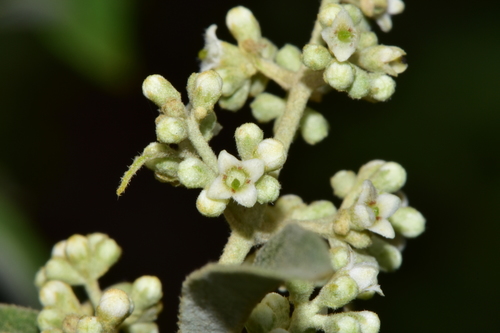
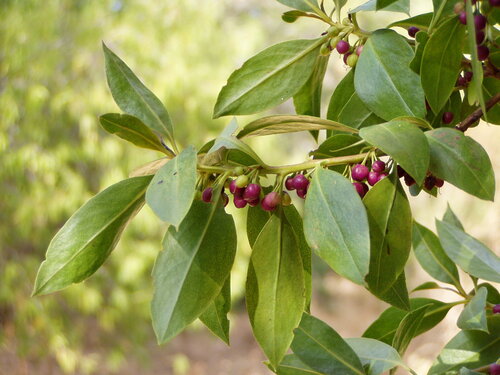
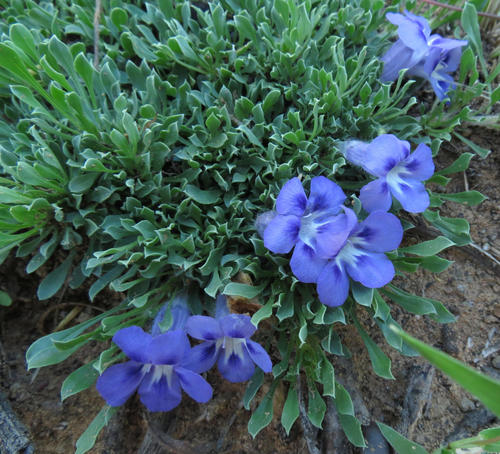
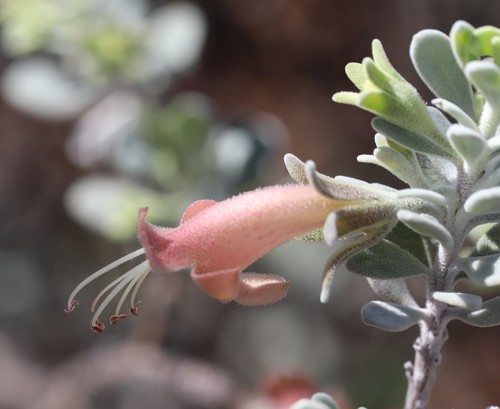
Eremophila forrestii F.Muell. is an erect, many-branched shrub that grows 0.5 to 2.0 metres (2 to 7 feet) tall. Its branches and leaves are covered in a thick, dense layer of branched greyish or bright lemon-yellow hairs that gives the plant a felty texture. Leaf shape varies by subspecies, ranging from lance-shaped to almost circular; leaves are typically 11–30 mm (0.4–1 in) long and 6–16 mm (0.2–0.6 in) wide. Flowers usually grow singly in leaf axils, on a 4–24 mm (0.2–0.9 in) long stalk that is covered in the same type of hairy layer found on the leaves. The five sepals are lance-shaped to egg-shaped, covered in a felty layer of hairs, and mostly 9–19 mm (0.4–0.7 in) long. Petals are mostly 18–25 mm (0.7–1 in) long, and are joined at the lower end to form a tube. The petal tube is cream to pink, with dark red spots or streaks on the inside of the petal lobes and the upper part of the petal tube. Both surfaces of the tube are covered in glandular hairs, and the hairs inside the tube are long. The four stamens extend past the end of the petal tube. Flowering occurs between April and October, and is followed by dry, oval-shaped to almost spherical fruits that are 6.5–9 mm (0.3–0.4 in) long with a papery covering. Regarding distribution and habitat, Eremophila forrestii subspecies forrestii is widespread and common, occurring from the west coast of Western Australia to the extreme southwest of the Northern Territory and the extreme northeast of South Australia, between latitudes 21°S and 30°S. In Western Australia, it occurs in the Eremaean and South West botanical provinces, and grows in a wide range of habitats, but is most common between sand dunes and on sand plains. Subspecies capensis is restricted to Cape Range National Park in the Carnarvon biogeographic region, where it grows in rocky limestone. Subspecies hastieana is common between Leonora and Nanutarra and in areas east of these localities, in the Carnarvon, Gascoyne, Murchison, Pilbara and Yalgoo biogeographic regions. It usually grows in mulga woodland, most often on red-brown clay or stony flats. Subspecies viridis, a little-known subspecies, is found near Onslow, Neale Junction and Well 38 on the Canning Stock Route. The unnamed "inland" subspecies is common and widespread, occurring from east of Warburton to Tom Price in the Gascoyne and Gibson Desert biogeographic regions, where it grows on sand dunes and sandplains.