About Eremophila duttonii F.Muell.
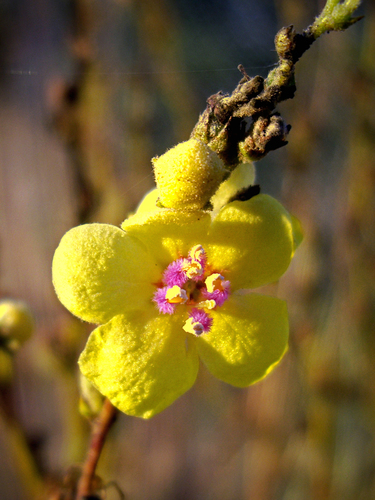
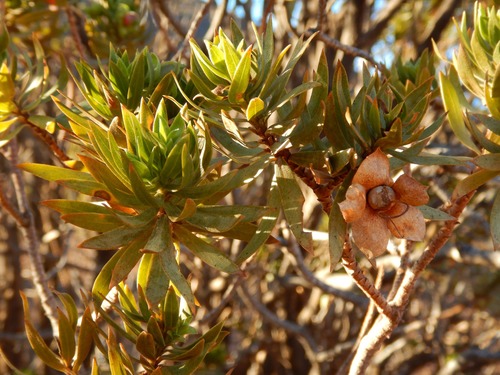
Eremophila duttonii F.Muell. is a shrub or small tree that grows to between 1 and 3.5 metres (3 to 10 feet) in height. Its branches are rough from persistent old leaf bases, and are hairy, shiny, and sticky due to resin. Leaves are arranged alternately along branches, sometimes clustered near branch tips, are mostly 30–40 mm (1–2 in) long and 3–5 mm (0.1–0.2 in) wide. They are linear to lance-shaped, taper towards their ends, and are sticky. Flowers are borne singly in leaf axils, on a stalk 10–20 mm (0.4–0.8 in) long. There are 5 overlapping, sticky, egg-shaped to elliptic sepals that measure 10–15 mm (0.4–0.6 in) long. Petals are 25–35 mm (0.98–1.4 in) long, joined at their lower end to form a tube. The top of the petal tube is red to orange, fading to yellowish-green below and inside the tube; occasionally the entire petal tube is yellow. The tube usually has a few short hairs on both its inner and outer surfaces, and is sticky on the outside. The 4 stamens extend beyond the end of the petal tube. Flowering occurs from June to September, and is followed by dry, oval to cone-shaped fruits with a pointed end, which are 7.5–13 mm (0.3–0.5 in) long. The westernmost distribution of Eremophila duttonii is the Warburton area of Western Australia. It also occurs in southern Northern Territory, South Australia, south-western Queensland, and western New South Wales as far east as Broken Hill. It grows in red-brown sandy soils on plains and hills. The Arrente people, who call this plant aherre-intenhe, collect its leaves for medicinal use. These uses include treating skin complaints, including those caused by the scabies mite. The leaves are also used as a gargle for sore throats, and to treat painful eye and ear conditions. A study of six eremophila species found that E. duttonii has the highest antimicrobial potency, especially against gram-positive bacteria, including strains resistant to the antibiotics meticillin and vancomycin. A separate study identified two diterpenes as the compounds responsible for this species' antimicrobial activity. Eremophila duttonii is rarely found in cultivation. It is difficult to propagate from both seed and cuttings, so grafting onto the rootstock of Myoporum species is often done to produce new plants. It is slow growing, prefers a dry, well-drained, sunny position, can tolerate light frosts, and is very drought tolerant.