About Eremophila alpestris (Linnaeus, 1758)
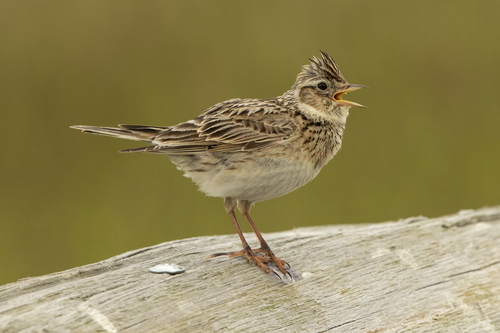
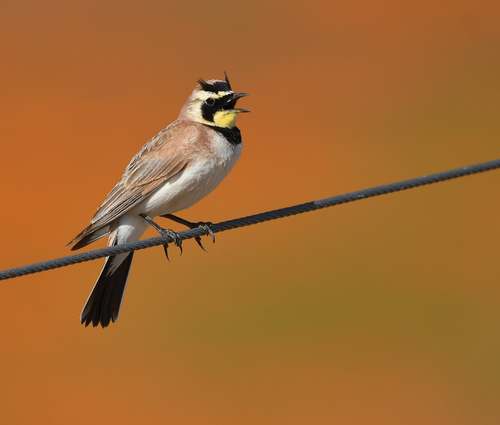
This species, commonly known as the horned lark, has a distinct appearance when on the ground that sets it apart from most other larks. Its upperparts are mainly brown-grey, and its underparts are pale, with a bold black and yellow face pattern. Most of its tail is black, with the exception of the central tail feathers, which creates a sharp contrast with the bird's paler body; this contrast is particularly visible when the bird is flying. Breeding males have black 'horns', which gives the species its common name in North America. A number of subspecies are found across North America, which differ in the male face pattern and back colour, especially during the summer. The southern European mountain subspecies Eremophila alpestris penicillata is greyer on its upperparts, and its face has white instead of yellow. This species measures 16–20 cm (6.3–7.9 in) in length, weighs 28–48 g (1.0–1.7 oz), and has a wingspan of 30–34 cm (11.8–13.4 in). Its calls are high-pitched, lisping or tinkling, and weak. Like most larks, it sings while in flight; its song starts with a few chips, followed by a warbling ascending trill. The horned lark breeds across much of North America, from the high Arctic south to the Isthmus of Tehuantepec, in the northernmost regions of Europe and Asia, and in the mountains of southeast Europe. It also has an isolated population on a plateau in Colombia. Most populations in the southern part of its range are year-round residents, while northern populations are migratory and travel further south for the winter. The horned lark inhabits open areas. In Eurasia, it breeds above the tree line in mountains and in the far north. Across most of Europe, it is most often found on flat coastal areas in winter, which gives it its European common name. In the UK, it occurs as a winter visitor along coasts and in eastern England. In North America, where no other larks compete with it, it can also be found on farmland, prairies, deserts, golf courses and airports.