About Eremiascincus richardsonii (Gray, 1845)
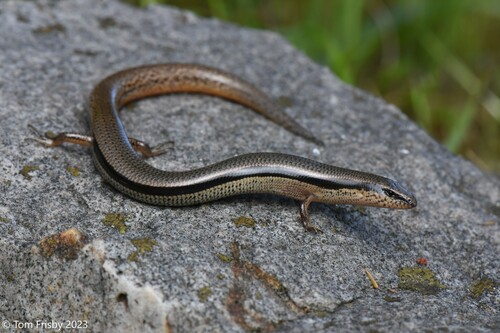
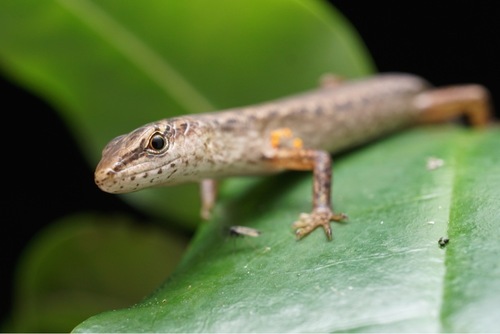
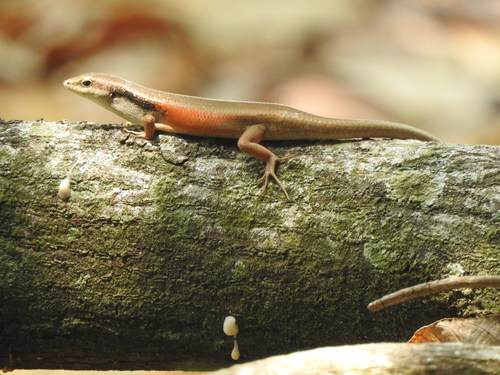
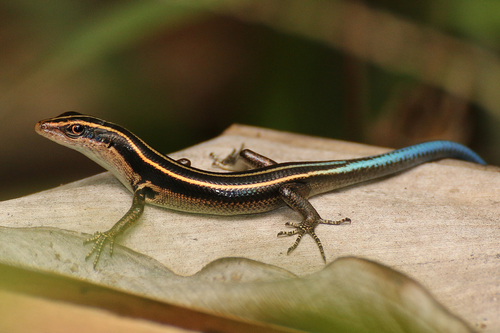
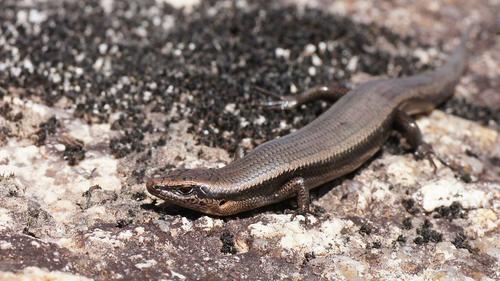
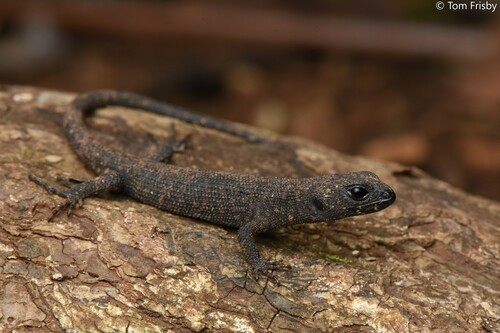
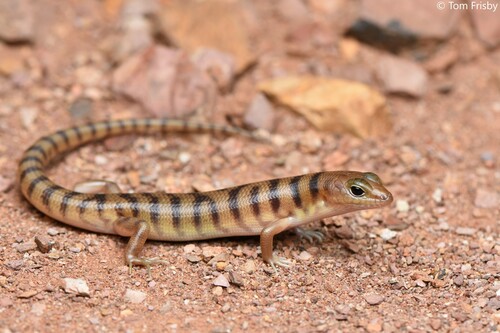
This species, Eremiascincus richardsonii, the Broad Banded Sand-Swimmer, is a medium-sized skink. Its maximum snout-to-vent length (SVL) is approximately 113mm, with an average SVL of 75mm. Its common name refers to its ability to effectively "swim" over sand while chasing and catching prey. Tail length varies, and can reach up to 171% longer than the SVL. It has a distinct appearance, though it shares many traits with Eremiascincus fasciolatus, the Narrow Banded Sand-Swimmer. It can be distinguished from other sand-swimmers by the pattern and number of its caudal bands. It has between 19 and 32 bands on its tail, while the Narrow Banded Sand-Swimmer has more, with 35 to 40 tail bands. On the nape, the Broad Banded Sand-Swimmer has 8 to 14 bands, and the Narrow Banded Sand-Swimmer has 10 to 19 narrow nape bands. The body bands of E. richardsonii are much broader, and generally less regular, than those of the Narrow Banded Sand-Swimmer. You cannot use caudal bands to identify this skink if it has lost its tail previously, because regrown tails do not develop caudal bands. The snout of E. richardsonii is less depressed than that of E. fasciolatus. Its body color can range from pale brown to dark reddish. Young hatchlings are bright yellow, and color variation can be seen in referenced images 1 and 2. Its scales are very shiny. It has five toes on each foot, on both forelimbs and hindlimbs. An additional identifying trait of E. richardsonii is that its parietal scales are in contact, not separated. This skink also has a transparent lower eyelid, a feature not found in skinks with round eyes; the transparent lower eyelid is associated with an elliptical eye shape. E. richardsonii is widely distributed across arid regions of Australia, and occurs across multiple Australian states that host desert-dwelling skinks. In Western Australia, it is found in areas including the Nullarbor Plain and the Tanami. In New South Wales, it occurs from the Northern Far Western Plains through to the Southern Far Western Plains across many intervening arid areas, with isolated occurrences in the Northern North Western Slopes of the state. In the Northern Territory, its distribution covers the Kimberly Desert and the Macdonnell Ranges. In South Australia, it can be found in the Simpson Desert and other arid regions. It is not known to inhabit arid areas of Victoria. While both banded skink species occupy sandy soils, E. richardsonii is not limited to desert sands, and can also be found on heavy and stony soils. As a nocturnal species, it can also be found in deep crevices, caves, and other dark areas such as rabbit holes. E. richardsonii was historically thought to be viviparous, meaning it carried live young. This was later determined to be incorrect. Newer studies confirm that E. richardsonii is actually oviparous, meaning it lays eggs. It commonly lays 4 to 5 eggs per clutch. One study found that clutch size increases slightly when the skink is larger. The same study also reported that female E. richardsonii reach sexual maturity at an SVL of 69mm, and males reach sexual maturity at an SVL of 67mm.