About Erechthias terminella (Walker, 1863)
Full-grown larvae of Erechthias terminella are about 1⁄2 inch long. They are elongated, slender, and almost uniformly thick, with the last three segments tapering toward the end. The head is red-brown and very glossy. The second body segment has a blackish horny dorsal plate. The rest of the body is straw-colored, darker on the underside, with the intestinal canal appearing black through the body wall. The skin is marked with transverse wrinkles, and a distinct lateral ridge is present. This larva is similar in general appearance to the larva of Erechthias hemiclistra, but it is smaller and has a darker median line.
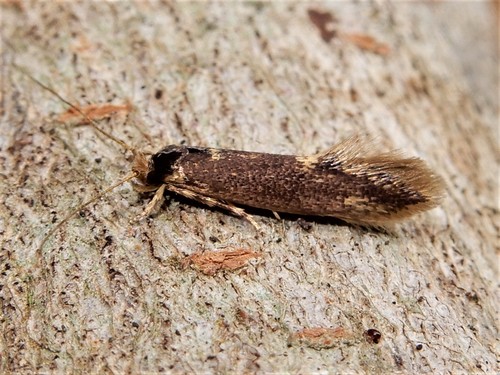
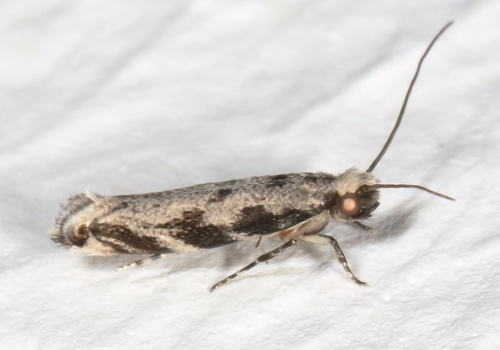
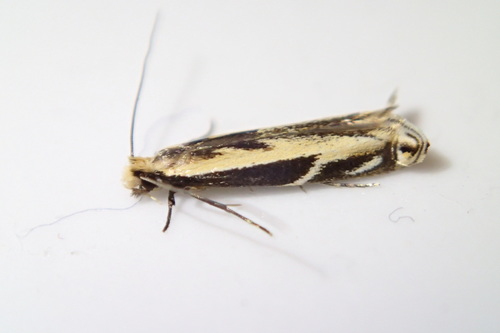
Adult Erechthias terminella have a wingspan of about 1⁄2 inch. The head and thorax are white, with a sharp dark brown marking along the anterior margin of the thorax. The forewings are blackish-brown. They have a straight central longitudinal creamy-white streak that runs from the base to the termen below the apex, growing slightly broader toward the apex with an irregular lower edge. Two oblique white streaks run from the costa: the first, near the middle, connects to the central streak; the second, located halfway between the first streak and the apex, is shorter and less distinct. The forewing cilia are white and contain a blackish oval apical spot. The hindwings are pale grey.
This species is endemic to New Zealand. It occurs throughout the North Island and in the upper regions of the South Island. It lives in native forest.
Larvae of E. terminella feed under a web made of silk and frass. They feed on the seeds, and possibly the pods, of Phormium tenax. They are also recorded feeding on the fruits of the New Zealand species Meryta sinclairii. Larvae have been reared from the dead bark or stems of Lupinus arboreus, pear trees, and species in the genus Tetragonia, as well as from the fruits of species in the genus Pittosporum.