About Erebia neoridas Boisduval, 1830
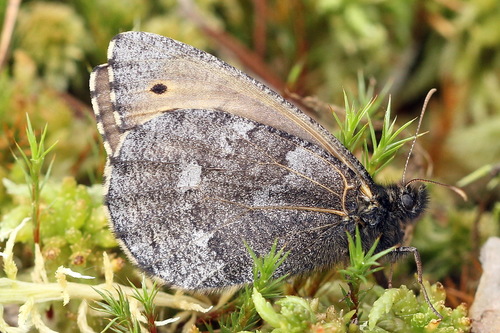
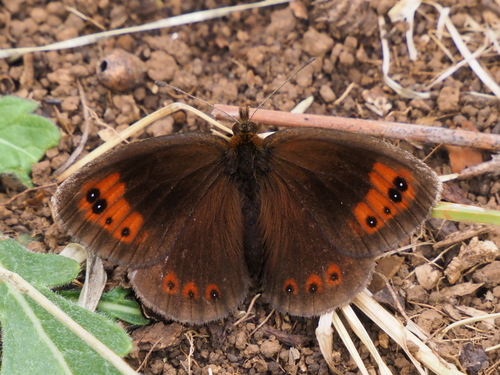
This species, Erebia neoridas Boisduval, 1830, is smaller than Erebia aethiops, the species it is most closely related to. On the forewing, the distal band is light russet; it appears yellowish red in females, is broader at the costa and narrower toward the posterior, has a sharp proximal edge, and is slightly incurved in the middle on its outer side. The anterior section of this band has two contiguous ocelli centered with white; a somewhat smaller ocellus, which only occasionally has a white center, sits near the hindmargin. The band on the hindwing is formed of 4 rounded or angular spots, 3 to 4 of which bear ocelli with tiny white pupils. Underneath the forewing, the band is more irregular and slightly darker russet than it is on the upper side, and the apex of the wing is dusted with bluish grey. The underside of the hindwing is grey-brown from its base to the middle; a proximally slightly dentate ashy grey band follows this section, and the distal area matches the base in colour. No ocelli are present on the underside of the hindwing. Females are lighter in overall colour than males, and their ocelli are usually somewhat larger than those of males. Fringes are brownish grey in males, and white-grey in females. Oberthur figured a small specimen from the Eastern Pyrenees as margarita; the upperside of this specimen strongly resembles the upperside of Erebia zapateri, while its underside matches that of neoridas. The nymotypical form of Erebia neoridas flies in the Basses Alpes, for example in the area around Digne. The egg is light grey, marked with dark ribs. The larva is greenish yellow, with a dark dorsal stripe, a whitish side stripe, and white spiracles bordered with dark. The brown head has two dark spots, and the legs are also brown. Larvae feed on Poa annua and Panicum sanguinale. Adult butterflies are active from June to September.