About Erebia flavofasciata Rühl, 1895
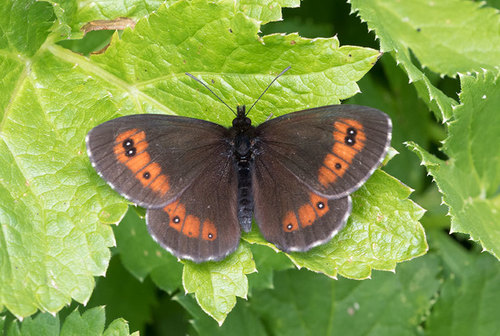
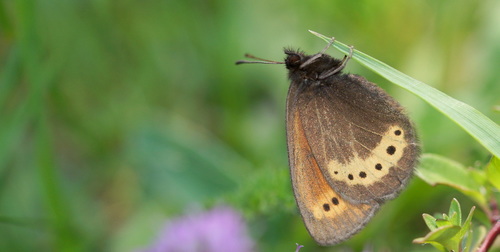
This description of Erebia flavofasciata Rühl, 1895, originally published in Seitz, refers to the species as E. flavofasciata Heyne. It is an Erebia species that was only recently discovered when first described. Lieutenant-Colonel von Nolte collected the first known specimens in July 1893 at Campolungo Pass near Fusio, in the Alps of Tessin. The species was later also found at Pontresina in the upper Engadine, in a form that only differs slightly from the original Tessin specimens. In shape and size, this species resembles Erebia cassiope, but its wing pattern is closer to that of Erebia melampus. Like most Erebias, the ground color of the wings is dark brown, and females are distinctly paler than males. The forewing has a narrow russet-brown distal band that is split by wing veins into 5 to 6 rounded or ovate spots, each marked with a small black dot. Spots in cellules 4 and 5 are generally somewhat elongated, and have larger black dots than the other spots. The upper surface of the hindwing has 4 rounded russet-yellow spots with black dots positioned before the outer margin. In females, these spots are larger and have stronger black dots. The underside of the forewing is greyish brown. The distal band on the underside is more yellow-brown, not split into separate spots like the upper surface, and is instead continuous and somewhat broader. The black dots stand out in sharp contrast on this underside band. The central forewing area has a faint red-brown tint that gradually fades toward the wing base. The underside of the hindwing is brownish grey. Positioned before the outer margin, parallel to the margin, is a fairly large straw-yellow band that stretches from the costal margin to near the anal angle. This band contains a row of 5 to 6 black dots of nearly uniform size, which are shifted slightly toward the distal end of the wing. Female individuals are lighter and brighter in color on their wing undersides than males. The Engadine form thiemei Bartel is darker than specimens from Tessin. The distal band of its forewing is separated into isolated spots of varying sizes. The number of these small spots, which only have faint black dots, varies, and the spots are sometimes underdeveloped. This form differs very little otherwise from the name-typical form. Adult butterflies of this species are found on steep grassy and rocky slopes. The host plant for this species' larvae is unknown. A Swiss subspecies, Erebia flavofasciata warreni, has been proposed.