About Erebia eriphyle (Freyer, 1836)
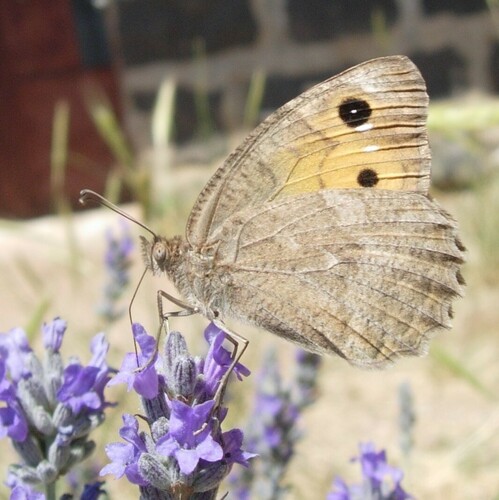
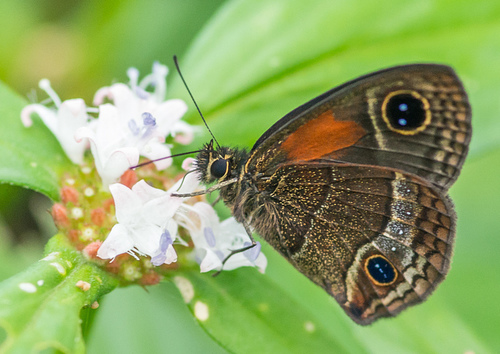
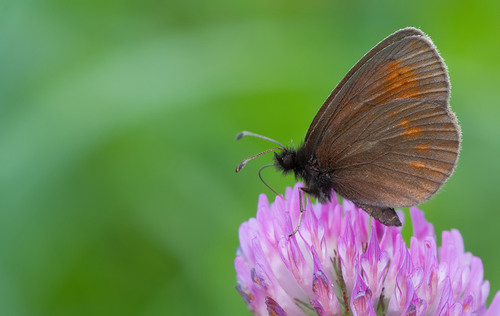
Scientific name: Erebia eriphyle (Freyer, 1836), described from Seitz as E. eriphyle Frr. (36 c). This Erebia, very closely related to Erebia melampus, was formerly classified only as a variety of the latter, but is consistently distinct as a separate species. The distal band of the forewing is more or less reddish brown, sometimes brown-yellow, separated by wing veins into several elongated spots with rounded distal edges. The number of these spots varies: there are usually 5, and sometimes only 3 to 4. The two spots positioned close to the outer margin bear small black dots. On the hindwing, there are 3 to 4 red-brown or brownish spots; the spot near the median vein in cellule 4 is placed a little further toward the wing base, and is always larger and more elongated, while in Erebia melampus this spot is never larger than the other hindwing spots. The shape and position of this spot, plus the absence of black central markings, are the main distinguishing characters of eriphyle, which is also distinctly larger than melampus. On the underside, the forewing band is lighter than on the upper surface, and is ochre-yellow in many specimens; the hindwing spots are the same colour, and are much more prominent than on the upper surface. In females, the wing ground-colour is paler; the underside is yellowish brown, and the band and spots are less distinct than in males. The distal margin is somewhat paler than the ground colour in males, and brownish grey in females. Antennae are black-brown above, and white-grey beneath. This species is an inhabitant of the Alps, prefers limestone terrain, and occurs in July and August at altitudes from 900 to 2200 m. The aberration ab. impunctata Hofn. differs in that the spots on both wings are larger, and the forewing band bears no black dots. In ab. tristis H.Schiff., from Graubunden and the Alps of Schwyz, the marginal band of the forewing is brighter in colour, and the disc of the hindwing beneath has a reddish flush. The aberration ab. intermedia Frey, from Carinthia, has more distinct reddish yellow spots, including on the hindwing.