About Eratigena agrestis (Walckenaer, 1802)
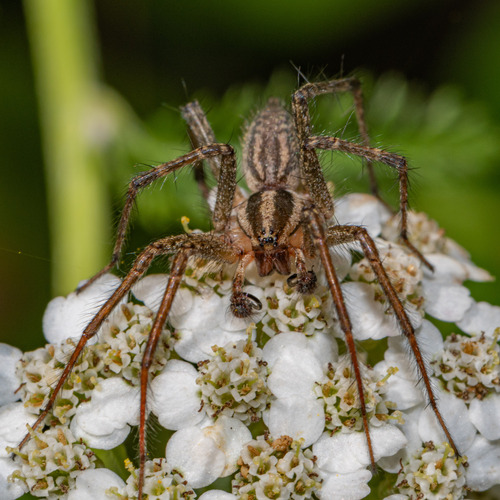
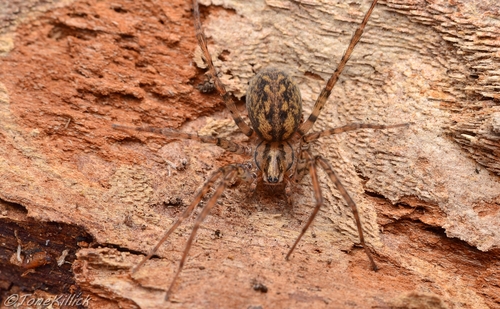
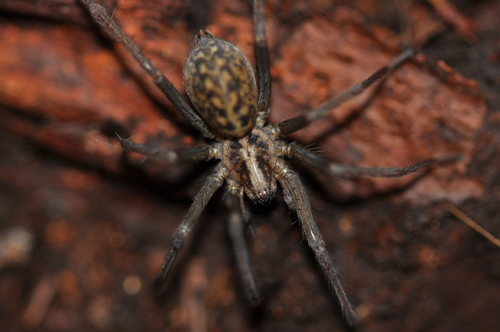
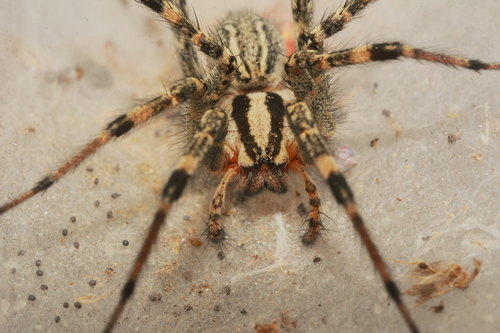
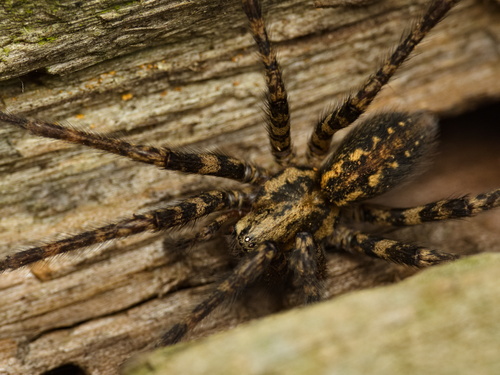
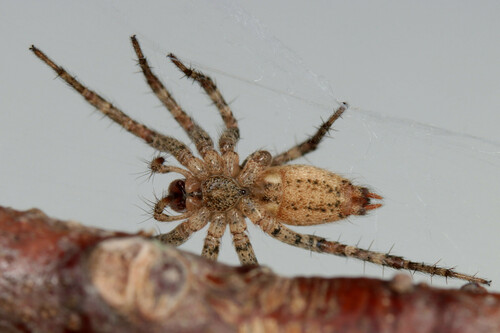
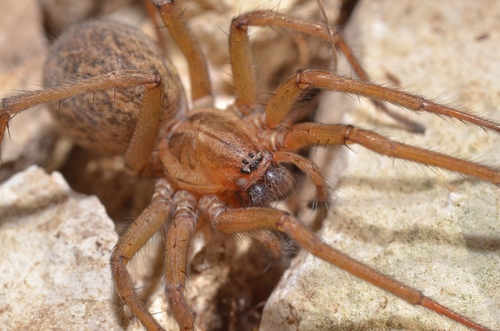
Identification: Spiders including the hobo spider (Eratigena agrestis) vary a great deal in appearance, so identification can be difficult. The hobo spider has a body length of 7–14 mm and is brownish in color. Proper identification depends on examination of the spider’s anatomy. Like many spider species, positive identification of Eratigena agrestis requires microscopic examination of the epigynum (female sex organ) and palpal bulb (male sex organ), and is best performed by an arachnologist. Even so, there are specific characteristics that can help identify hobo spiders among other species with a similar general appearance. Unlike many other members of the family Agelenidae, hobo spiders do not have colored bands at their leg joints. Their abdomen has one or more chevron (V-shaped) patterns down the middle, with the chevrons pointing toward the head. Hobo spiders also have a light stripe running down the center of the sternum. If a spider of this group has three or four pairs of light spots on the lateral portions of its sternum, it belongs to one of the other two related Eratigena species. However, the absence of these spots is not conclusive proof that a spider is a hobo spider, because the spots on other Eratigena species may be extremely faint and not easily visible. Hobo spiders do not have two distinct longitudinal dark stripes on the top of the cephalothorax; instead, they show indistinct or diffused patterns. In Washington state, spiders with distinct dark stripes include species from the genera Agelenopsis and Hololena, and possibly some wolf spiders. Distribution and habitat: Eratigena agrestis is distributed from Europe to Central Asia, and is also found in western North America, specifically the Pacific Northwest and Great Basin. It is included in the checklist of Danish spider species, and is present on the small artificial island of Peberholm, where it was likely carried by trains. It lives in open fields, and avoids human habitations that are occupied by major competitors, particularly the giant house spider (Eratigena atrica), which is a common resident of houses and other man-made structures across Europe. Because of this, human contacts with the hobo spider are uncommon in Europe. Hobo spiders build horizontal, trampoline-like webs near brick walls or wood piles, where they have access to shelter while waiting for prey. Hobo spiders lay their eggs in September, and the eggs hatch during late spring. After mating, male hobo spiders die.