About Erasmoneura vulnerata (Fitch, 1851)
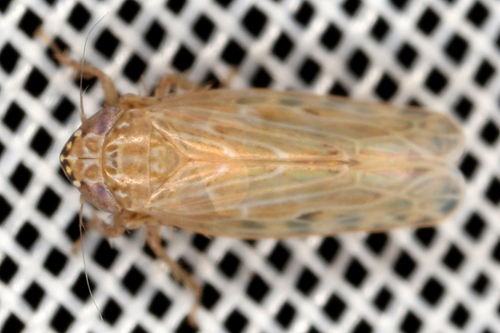
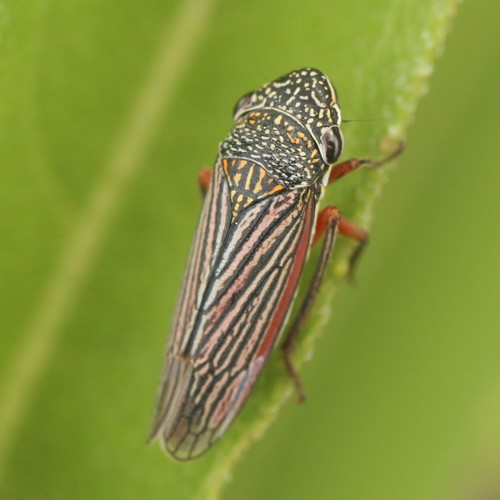
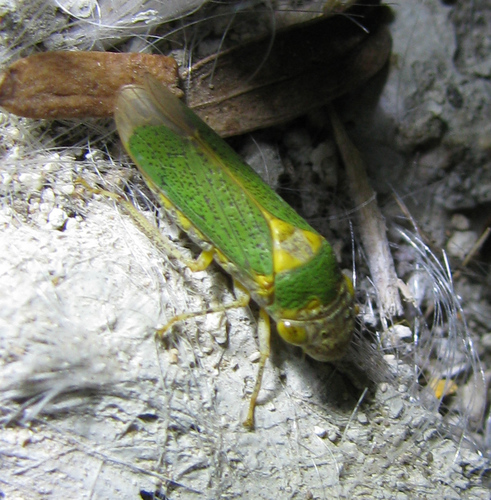
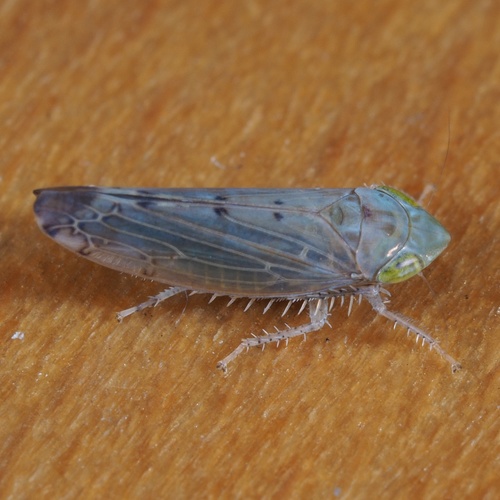
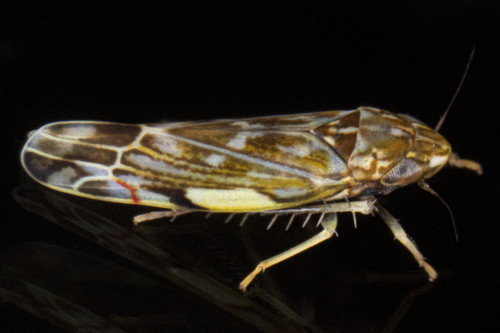
Erasmoneura vulnerata, first formally described by A. Fitch in 1851, is a species of leafhopper. Adult body length ranges approximately 2.7 to 3.2 mm, and adults have a longitudinal yellow stripe that divides their body. The species exhibits seasonal color dimorphism: the summer population has a red transverse vein at the base of the first apical cell, plus bluish patches on the forewings. Late in the season, these patches become more green-brown, and the transverse veins often appear white. Nymphs have a reddish-brown body marked with yellow marbled patches, light green legs, and a dorsoventrally flattened thorax and vertex. Fitch’s 1851 original description reads: "Wounded erythroneura E. vulnerata. Fulvous-brown spotted and lined with whitish; elytra with an abbreviated yellowish-white vitta on the outer margin, interrupted near the middle by an oblique sanguineous one; tips dusky, with whitish nervures and spots; a whitish medial line common to the vertex, thorax and scutel; beneath black, legs pallid. Length 0.12, on raspberry bushes, grape vines and other situations where the foliage is dense, often in great numbers". This species is native to North America, where it is widely distributed across Canada, the USA, and Mexico. It was first detected as an invasive species in Europe in 2004, when it was found on Vitis vinifera in the Veneto region of northern Italy. By 2005, it had spread to other nearby Italian regions; it was found in Slovenia by 2010, Romania in 2018, Switzerland in 2019, and a small number of occurrences have recently been recorded in Serbia. Leafhoppers spread easily by flight, and can also attach to and travel with cars to accelerate their spread. In both its native and invaded range, E. vulnerata is commonly found on the foliage of Vitis in vineyards. Within its native range, it has been repeatedly recorded on wild Vitis, typically in wooded areas and along riverbanks. In winter, adult E. vulnerata migrate to overwintering sites, which can be under plant debris, in woody areas, near hedgerows, or near rural buildings. In its native range, adults overwinter near vineyard margins with sufficient canopy cover, inside plant structures or organic material. Observations in Italy confirm that buildings and hedgerows near vineyards are also important overwintering sites for the leafhopper; common overwintering host plants include canopy of Vitis labrusca and Vitis vinifera cultivars. Beginning in April around bud break, adults move from overwintering sites into vineyards. In the native range, female leafhoppers lay eggs inside vascular bundles on the leaf midrib, and also on the top surface of leaves. E. vulnerata is hemimetabolous, and develops through five nymphal instars. Early instar nymphs are first detected in late May, and older nymph populations peak in June. Egg development takes 16 to 20 days, and full development to adulthood takes 35 to 38 days. Two generations per year occur in the species’ native range. However, three peaks in nymph density have been recorded in Europe, indicating the species can produce three generations per year in this invaded range. The second generation is the most abundant.