About Equus quagga Boddaert, 1785
Physical description: The plains zebra (Equus quagga) stands 127–140 cm (50–55 in) tall at the shoulder, with a head-to-body length of 217–246 cm (85–97 in) and a tail length of 47–56.5 cm (18.5–22.2 in). Males weigh 220–322 kg (485–710 lb), while females weigh 175–250 kg (386–551 lb). It is intermediate in size between the larger Grévy's zebra and the smaller mountain zebra. It has a stocky, dumpy build with relatively short legs, a skull with a convex forehead and a slightly concave nose profile. Males have thicker necks than females. Its ears are upright with rounded tips: they are shorter than the mountain zebra's ears, and narrower than Grévy's zebra's ears. Like all wild equids, the plains zebra has an erect mane running along its neck and a tuft of hair at the tip of its tail. The body hair of a plains zebra averages 9.4 ± 4 mm (0.37 ± 0.16 in) in length, which is shorter than the body hair of other African ungulates.
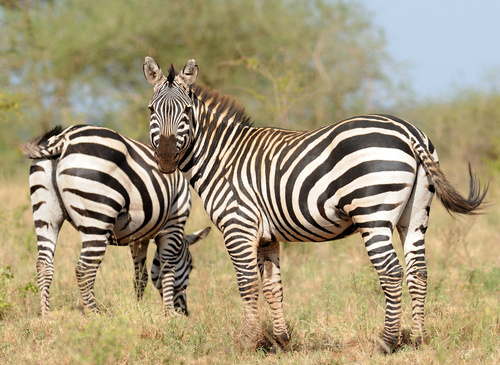
Like all zebras, plains zebras have bold black-and-white stripes, and no two individuals have identical stripe patterns. Compared to other zebra species, the plains zebra has broader stripes. Stripes are vertical on the front half of the body, and become more horizontal on the hindquarters. Northern plains zebra populations have narrower, more clearly defined striping; southern populations have varied but reduced striping on the underparts, legs, and hindquarters. Southern populations also have brown "shadow" stripes between the black and white stripes, which are absent or barely visible in northern zebras. A newborn foal has a brown-and-white natal coat, and the brown darkens as the foal ages.
Multiple stripe pattern abnormalities have been recorded in plains zebras. Melanistic zebras have high concentrations of dark stripes on the torso but low concentrations on the legs. "Spotted" individuals have breaks in their black striping patterns. There have even been morphs with white spots on dark backgrounds. Striping abnormalities have been linked to inbreeding. Albino zebras have been documented in the forests of Mount Kenya, where their normally dark stripes are blonde. The extinct quagga subspecies had brown and white stripes only on the head and neck, brown upper body, and a white belly, tail, and legs.
Range and habitat: The current range of the plains zebra does not extend into the Sahara. It runs from South Sudan and southern Ethiopia southward through eastern Africa, reaching as far as Zambia, Mozambique, and Malawi, before spreading into most southern African countries. The species may have occurred in Algeria during the Neolithic era. Plains zebras most commonly live on treeless grasslands and in savanna woodlands, but can occupy a range of both tropical and temperate habitats. They are generally not found in deserts, dense rainforests, or permanent wetlands. They generally prefer Acacieae woodlands over Commiphora woodlands. They depend on access to water, and live in more mesic (moister) environments than other African equids. They rarely travel more than 10–12 km (6.2–7.5 mi) from a water source. Plains zebras live at elevations ranging from sea level up to 1,300 m (4,300 ft) on Mount Kenya.
Depending on the population, plains zebra herds may be sedentary, with high population density and small home ranges, or migratory, with lower population density and separate extensive home ranges for the dry and wet seasons. When migrating, zebras appear to rely on memory of past locations with good foraging conditions, and may predict foraging conditions months before arriving at new sites. The loss of open grasslands caused by woody plant encroachment increases predation risk, and as a result reduces available habitat.
Reproduction and parenting: In a harem group, the lead stallion mates with all of his mares. Males perform the flehmen response to test if a female is receptive to mating: this response involves curling the upper lip back to sample urine scent via the vomeronasal organ. A receptive female signals her readiness for copulation by spreading her legs and raising her tail. Gestation lasts approximately one year, and a single foal is born per pregnancy. Mares can give birth to one foal every twelve months. Most births occur during the rainy season. A mare gives birth near her herd, while lying down on her side. A newborn foal weighs 30–35 kg (66–77 lb), and the afterbirth is rarely consumed. Newborn foals are able to stand almost immediately after birth, and start eating grass within one week. Immediately after birth, the mother zebra keeps all other zebras away from her foal, including the harem stallion, other mares, and even her own previous offspring. Over time, all members of the group bond with the new foal. Within the herd, a foal holds the same social rank as its mother. The harem stallion is generally not tolerant of foals that are not his own, and plains zebras may practice infanticide and feticide.
Foal mortality is high during the first year of life, most often due to predation. Even so, young zebras receive more protection from adults than the young of species like wildebeest and hartebeest. Foals are usually weaned around eleven months of age, but may continue suckling for longer. Female plains zebras reach puberty before three years of age, while males reach puberty after five or six years. Young male zebras eventually leave their natal family groups, as their relationship with their mother fades after a new sibling is born. The young stallion then joins other young stallions for company. Young females may remain in their natal harem until they are taken away by another stallion. The average lifespan of a plains zebra in the wild is 25 years.