About Equus kiang Moorcroft, 1841
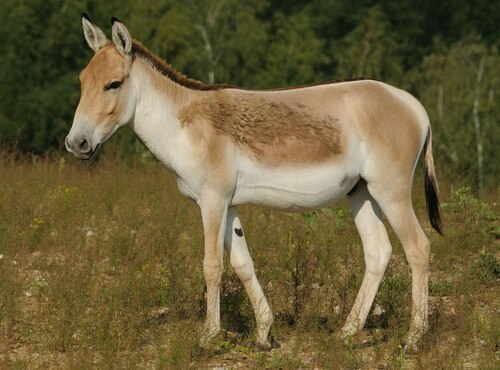
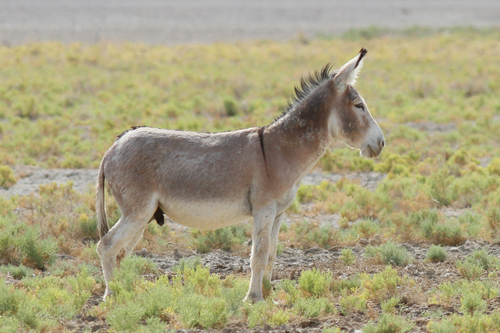
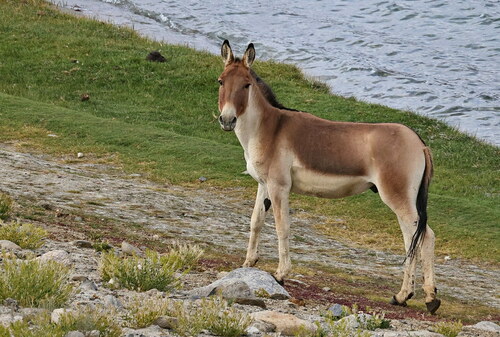
The kiang, scientifically named Equus kiang Moorcroft, 1841, is the largest species of wild ass. Its average height at the withers is 140 cm (55 in), with an overall height range of 132 to 142 cm (52 to 56 in) at the same point. Their body length measures 182 to 214 cm (72 to 84 in), and their tails are 32 to 45 cm (13 to 18 in) long. Sexual dimorphism in kiangs is only slight: males weigh 350 to 400 kg (770 to 880 lb), while females weigh 250 to 300 kg (550 to 660 lb). Kiangs have a large head with a blunt muzzle and a convex nose. Their mane is upright and relatively short. Their coat is a rich chestnut color, turning darker brown in winter, and becoming a sleek reddish brown in late summer when the animal molts its woolly fur. The summer coat is 1.5 cm (0.6 in) long, and the winter coat is twice that length. The legs, underparts, end of the muzzle, and the inside of the ears are all white. A broad, dark chocolate-colored dorsal stripe runs from the mane to the end of the tail, which terminates in a tuft of blackish brown hairs. The kiang's distribution range extends from the Kunlun Mountains in the north, across the Tibetan Plateau, to the Himalayas in the south. Most kiangs live within China, but an estimated 2,500–3,000 kiangs inhabit the Ladakh, Himachal Pradesh, and Uttarakhand regions of India, with smaller numbers found along the northern frontier of Nepal. Kiang herds live in alpine meadows and steppe terrain at elevations between 2,700 and 5,300 m (8,900 and 17,400 ft). They prefer relatively flat plateaus, wide valleys, and low hills that are dominated by grasses, sedges, and smaller amounts of other low-lying vegetation. This open terrain provides them with suitable forage not found in the more arid regions of central Asia, and may also make it easier for them to detect and flee from predators. Kiangs are herbivores that feed on grasses and sedges, especially Stipa, but they also eat other plants including bog sedges, true sedges, and meadow grasses. When little grass is available, such as during winter or in the more arid edges of their native range, kiangs have been observed eating shrubs, herbs, and even roots of Oxytropis that they dig from the ground. While kiangs do sometimes drink from waterholes, these water sources are rare on the Tibetan Plateau, so they likely get most of their water from the plants they eat, or possibly from snow during winter. Kiangs sometimes gather in large herds that may number several hundred individuals. These herds are not permanent social groups, however; they are temporary aggregations that consist either of only young males, or of mother kiangs and their foals. Older males are typically solitary, defending a territory of about 0.5 to 5 km² (0.19 to 1.93 sq mi) from rival males, and dominating any local groups of females. Territorial males sometimes become aggressive toward intruders, kicking and biting them, but more often they chase intruders away after a threat display that involves flattening their ears and braying. Kiangs mate between late July and late August. During this time, older males court reproductive females by trotting around them, then chasing them before mating occurs. Gestation length has been reported variously as between seven and 12 months, and results in the birth of a single foal. Females are able to breed again almost immediately after giving birth, though births every other year are more common. Foals weigh up to 35 kg (77 lb) at birth, and are able to walk within a few hours. The age at which kiangs reach sexual maturity is unknown, but it is likely around three or four years, matching the timeline of the closely related onager. Kiangs can live up to 20 years in the wild.