About Equus hemionus Pallas, 1775
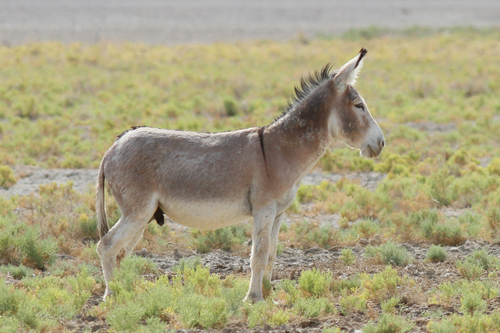
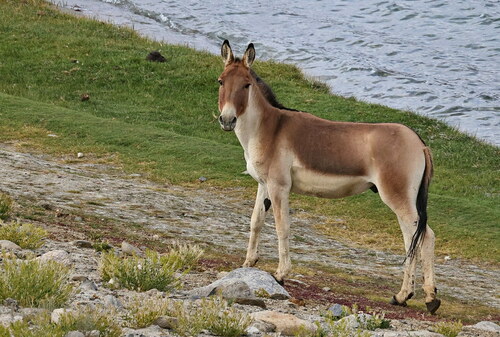
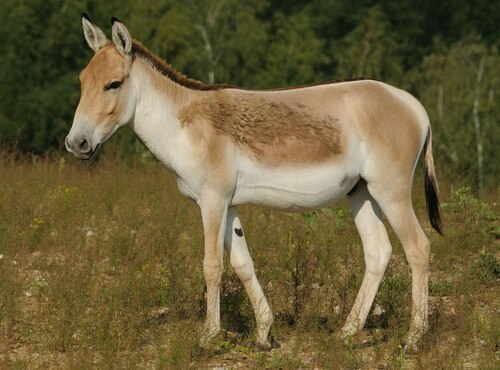
The onager (Equus hemionus) generally has a reddish-brown coat in summer, which changes to yellowish-brown or greyish-brown in winter. It has a black stripe bordered in white that runs down the middle of its back. Its belly, rump, and muzzle are white, except for the Mongolian wild ass, which also has a broad black dorsal stripe bordered with white. Adult onagers weigh 200 to 260 kg (440 to 570 lb) and measure 2.1 to 2.5 m (6 ft 11 in to 8 ft 2 in) in head-to-body length, and males are usually larger than females. Onagers favor habitats including desert plains, semideserts, oases, arid grasslands, savannahs, shrublands, steppes, mountainous steppes, and mountain ranges. The Turkmenian kulan and Mongolian wild ass are known to inhabit both hot and colder deserts. The IUCN estimates that around 28,000 mature onagers remain in the wild. Around 40,000 years ago during the late Pleistocene, the Asiatic wild ass had a wide range across Europe, and from southwestern to northeastern Asia. Middle Pleistocene fossils of the species have also been found in Saudi Arabia's Nefud Desert. The species is regionally extinct in Israel, Saudi Arabia, Iraq, Jordan, Syria, and southern Siberia. The Mongolian wild ass, the most common subspecies, lives in deserts, mountains, and grasslands of Mongolia and the Inner Mongolian region of northern China; a small number also live in the Kalamaili Nature Reserve in northern Xinjiang, northwestern China. The Gobi Desert is this subspecies' main stronghold. Its population has dropped drastically to a few thousand due to decades of poaching and habitat loss across East Asia, and it is regionally extinct in eastern Kazakhstan, southern Siberia, and the Manchurian region of China. The Indian wild ass was once found throughout arid areas and desert steppes of northwest India and Pakistan; around 4,500 individuals remain today, located in a small number of very hot wildlife sanctuaries in Gujarat, India. The Persian onager has two separate subpopulations in southern and northern Iran, with the largest subpopulation located in Khar Turan National Park, and it is extinct in Afghanistan. The Turkmenian kulan was once widespread across central to northern Asia; today it is found in Turkmenistan, and has been reintroduced to southern Kazakhstan and Uzbekistan. Asian wild asses reach sexual maturity at two years old, and first mating typically occurs when individuals are three to four years old. Breeding is seasonal, with mating and births taking place from April to September, and most events occurring between June and July; in India, the mating season falls during the rainy season. The gestation period for onagers is 11 months, and birth takes just over 10 minutes. A foal can stand and begin nursing within 15 to 20 minutes of birth. Females with young tend to form groups of up to five individuals. While rearing a foal, the dam stays close to her young and chases away other animals, including her own older offspring. Occasionally, stallions in territorial wild populations expel the young to mate with the mare again. Wild Asian wild asses live up to 14 years of age, while captive individuals can live up to 26 years.