About Equus grevyi Oustalet, 1882
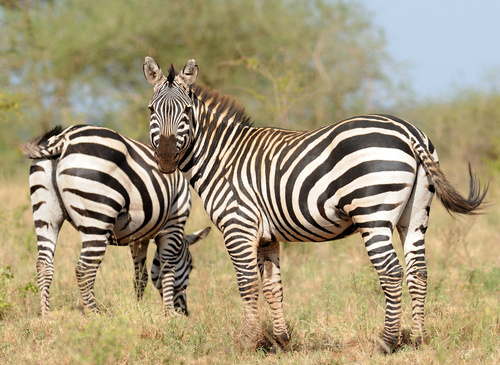
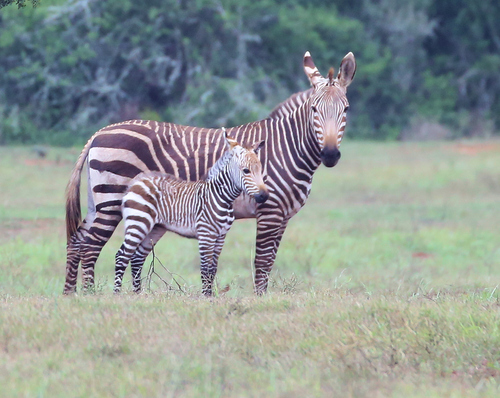
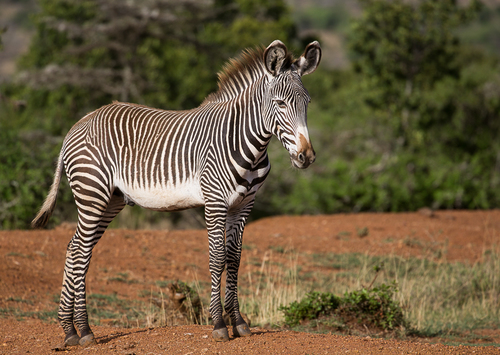
Grévy's zebra, with the scientific name Equus grevyi Oustalet, 1882, is the largest species of wild equine. It measures 2.5–2.75 m (8.2–9.0 ft) from head to body, has a tail 55–75 cm (1.80–2.46 ft) long, stands 1.45–1.6 m (4.8–5.2 ft) high at the withers, and weighs 350–450 kg (770–990 lb). Compared to the other two zebra species, Grévy's zebra has more primitive physical characteristics. It has a distinctly mule-like appearance: its head is large, long, and narrow with elongated nostril openings; its ears are very large, rounded, and conical; and its neck is short but thick. Its muzzle ranges from ash-grey to black in color, and its lips have whiskers. Its mane is tall and erect; juvenile Grévy's zebras have a mane that runs the full length of the back, which shortens as the animal reaches adulthood. Like all zebra species, Grévy's zebra has a black and white striped coat. Its stripes are narrow and closely spaced, broader on the neck, and extend all the way to the hooves. Uniquely among zebras, the belly and the area around the base of the tail are solid white with no striping. Newborn foals have brown and white striping, and the brown stripes darken as the foal ages. Grévy's zebra mostly lives in northern Kenya, with some small isolated populations remaining in Ethiopia. It was completely wiped out from Somalia and Djibouti, and its current presence in South Sudan is unconfirmed. The species inhabits Acacia-Commiphora bushlands and barren plains. Ecologically, Grévy's zebra falls between the arid-adapted African wild ass and the water-dependent plains zebra. Lactating female mares and non-territorial male stallions use areas with green, short grass and medium-density, dense bush more often than non-lactating mares and territorial stallions. Grévy's zebras get nutrition from grasses, forbs including legumes, and browse. They commonly feed on browse when grasses are not abundant. Their hindgut fermentation digestive system lets them survive on lower-quality diets than ruminant herbivores require. Grévy's zebras can survive for up to one week without water, but they drink daily when water is easily available. During the dry season, they often migrate to better-watered highland areas. Lactating mares need significantly more water than non-lactating mares. During droughts, Grévy's zebras dig their own water holes and will defend these holes. The main predator of Grévy's zebra is the lion, though spotted hyenas also hunt the species. African wild dogs, cheetahs, and leopards almost never attack adult Grévy's zebras even when resources are extremely scarce, but they sometimes prey on young foals. Mares are fiercely protective of their young against these predators. Grévy's zebra is also susceptible to a variety of gastrointestinal parasites, most notably those from the genus Trichostrongylus. Grévy's zebras can mate and give birth year-round, but most mating occurs during early rainy seasons, and most births happen in August or September after the long rains. A mare in oestrus may visit up to four different stallion territories per day, and will mate with the stallions that hold each territory. Among territorial stallions, the most dominant individuals control territories located near water sources, which mostly attract mares with dependent foals. More subordinate stallions control territories farther from water that have more vegetation, which mostly attract mares without dependent foals. Resident stallions will attempt to subdue entering mares through dominance rituals before moving on to courtship and copulation. Grévy's zebra stallions have large testicles and can ejaculate a large volume of semen to displace sperm left by other males. This is a useful adaptation for the species, as mares mate with multiple males. Bachelor stallions or non-resident territorial stallions sometimes sneak copulations with mares located inside another stallion's territory. While associations between mares and individual stallions are brief and mating is promiscuous, mares that have just given birth will stay within a territory protected by a territorial stallion. Since lactating mares have higher water requirements than non-lactating mares, and stallions typically control areas near water, this arrangement works in the mares' favor. Lactating females are harassed by stallions more often than non-lactating females, so associating with a single male and his territory gives an advantage, as the resident stallion will guard the mare against other males. Grévy's zebra gestation normally lasts 390 days, or 13 months, and results in the birth of a single foal. A newborn Grévy's zebra will follow any moving object, so new mothers prevent other mares from approaching their foals while imprinting their own striping pattern, scent, and vocalization on the foal. Mares with young foals may gather into small groups. When grazing conditions are poor, mares may leave their foals in "kindergartens" within a stallion's territory while they travel to search for water. Foals do not hide, so they are vulnerable to predators in these groups. Even if the foal is not his, the territorial stallion will tolerate the foal's presence to keep the mare in his territory. To adapt to the species' semi-arid environment, Grévy's zebra foals nurse at longer intervals and do not start drinking water until they reach three months old. While offspring become less dependent on their mothers after six months, they may stay associated with their mothers for up to three years.