About Equus asinus Linnaeus, 1758
Donkeys (Equus asinus Linnaeus, 1758) vary significantly in size based on breed and environmental conditions, with wither heights ranging from less than 90 centimeters (35 inches) to around 150 cm (59 inches). Working donkeys in the world's poorest countries have a life expectancy of 12 to 15 years, while donkeys in more prosperous regions can live 30 to 50 years.
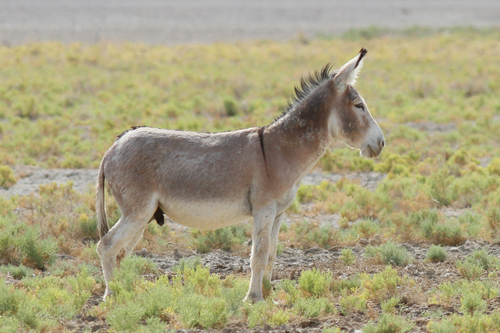
Donkeys are adapted to marginal desert lands. Unlike wild and feral horses, wild donkeys in dry areas live solitarily and do not form harems. Each adult donkey establishes its own home range, and breeding across large areas may be dominated by a single jack (male donkey). A donkey's loud call, called a bray, typically lasts twenty seconds and can be heard from over three kilometers away; this call helps donkeys stay in contact with one another across the wide open spaces of the desert. Donkeys have large ears, which allow them to pick up more distant sounds and may also help cool their blood. Donkeys can defend themselves via biting, striking with their front hooves, or kicking with their hind legs. In English, a donkey's bray is often written as "hee haw".
Donkeys have been used as working animals for at least 5,000 years. Of the more than 40 million donkeys in the world, approximately 96% live in underdeveloped countries, where they are primarily used as pack animals or for draught work in agriculture and transport. Donkeys are the cheapest source of agricultural power after human labor. They may also be ridden, or used for threshing, raising water, milling, and other work tasks. Some cultures that bar women from working with oxen in agriculture do not apply this taboo to donkeys.
In developed countries where donkeys are no longer used as beasts of burden, they are used to sire mules, guard sheep, provide donkey rides for children or tourists, and kept as pets. Donkeys can be pastured or stabled alongside horses and ponies, and are considered to have a calming effect on nervous horses. If a donkey is introduced to a mare and her foal, the foal will often turn to the donkey for support after it is weaned from its mother. In the United States, Canada, and Australia, donkeys are used as livestock guard animals for smaller livestock such as sheep. In this role, also referred to as predator control animals or mobile flock protectors, donkeys bray loudly to alert of predators and attack potential threats by kicking with their front hooves. In 2019, donkeys made up 14.2% of all livestock guard animals in the United States.
A small number of donkeys are milked or raised for meat. Around 3.5 million donkeys and mules are slaughtered for meat each year worldwide. Italy, which has the highest equine meat consumption in Europe and uses donkey meat as a main ingredient in multiple regional dishes, slaughtered approximately 1,000 donkeys in 2010, producing around 100 tonnes of meat. Donkey (ass) milk can command high prices: the 2009 average price in Italy was €15 per liter, and a 2008 report from Croatia recorded a price of €6 per 100 ml. Asses' milk is used in soaps and cosmetics, as well as for dietary purposes. Niche markets for both donkey milk and meat are expanding. Historically, donkey skin was used to make parchment. In 2017, UK-based charity The Donkey Sanctuary estimated that 1.8 million donkey skins are traded annually, though global demand could be as high as 10 million skins per year.
In China, donkey meat is considered a delicacy, with some restaurants specializing in donkey meat dishes, and Guo Li Zhuang restaurants even serve donkey genitalia as a menu item. Donkey-hide gelatin is produced by soaking and stewing donkey hide to make a traditional Chinese medicine product called ejiao. By October 2017 prices, ejiao can sell for up to $388 per kilogram.