About Equisetum telmateia Ehrh.
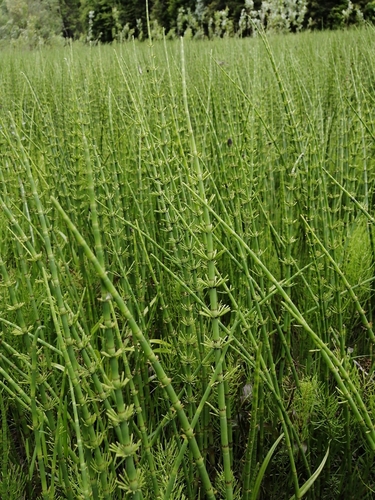
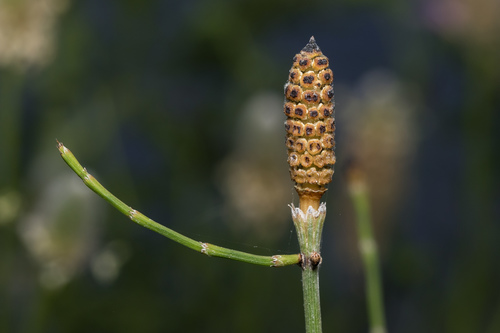
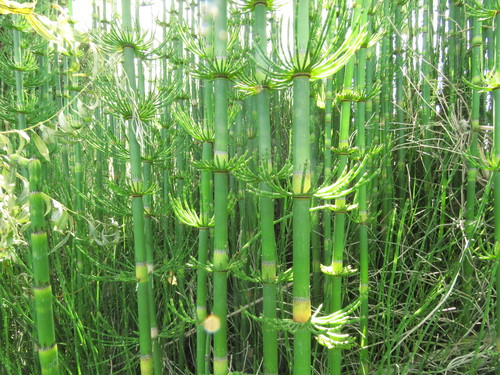
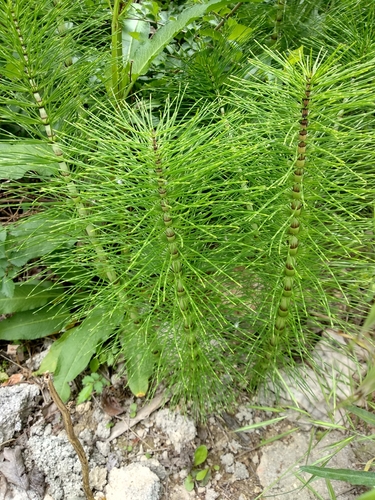
Equisetum telmateia Ehrh. is a herbaceous perennial horsetail with two distinct stem types: separate green photosynthetic sterile stems, and pale yellowish non-photosynthetic spore-bearing fertile stems. Sterile stems emerge in late spring and die back in late autumn. They reach 30 to 150 cm tall, rarely growing as tall as 240 cm, making this the tallest horsetail species outside tropical regions. These stems have a 1 cm diameter, are heavily branched, and bear whorls of 14 to 40 unbranched branches that grow up to 20 cm long, with a 1 to 2 mm diameter. The branches emerge from the axils of a ring of bracts. The main stem itself is whitish, lacking chlorophyll and stomata. Fertile stems grow in early spring before sterile shoots develop, reaching 15 to 45 cm tall, with no side branches. They bear an apical spore-producing strobilus that is 4 to 10 cm long and 1 to 2 cm broad. Spores disperse in mid spring, and fertile stems die immediately after spore release. Rarely, individual plants can produce stems that are both fertile and photosynthetic. This species also spreads via rhizomes, which have been recorded penetrating 4 metres deep into wet clay soil, spreading laterally in multiple layers. Great horsetail, the common name for this species, is widespread across most of Europe north to 56° to 58° N. In Ireland and Great Britain it is widespread and often common in suitable habitats, but it is scarcer in Scotland, particularly north of the Central Belt, with the exception of a notable concentration on Skye. The northernmost known population of this species anywhere is located near Thurso on the north coast of Scotland, at approximately 58°35' N. Further east, the species does not extend as far north; in Sweden it is rare and endangered, restricted to just three locations on the west coast of the southern province of Skåne, reaching no further north than about 56°08' N. Its southern and eastern range limits are not well mapped, but it occurs as far south as Madeira (32°45' N), the Atlas Mountains in northwest Africa, and Israel, and extends east to Iran. The easternmost research-grade iNaturalist record of the species is at 52°58' E in Iran. This species grows in damp shady places, spring fens, and seepage lines, most often in open woodlands, where it commonly forms large clonal colonies.