About Equisetum hyemale L.
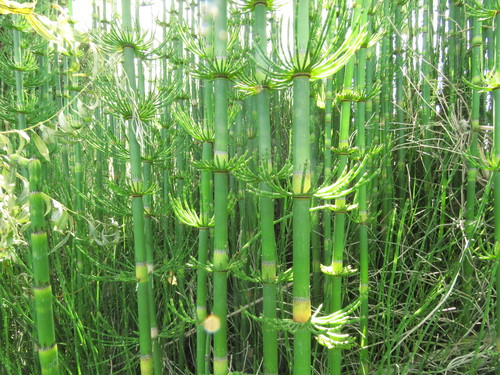
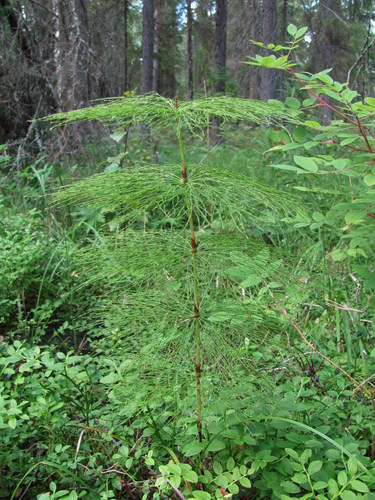
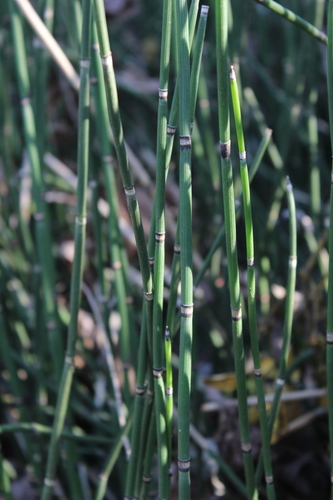
Equisetum hyemale L. has vertical, jointed, reed-like stalks that are medium to dark green. The hollow stems grow 30–100 centimetres (12–39 in) tall and are rarely branched. They are 3–6 mm thick, with 10–30 conspicuous ridges impregnated with silica, making the stems rough to the touch; this roughness is the origin of the plant’s common English name. Tiny leaves are joined around the stem, forming a narrow black-green band or sheath at each joint. Like other pteridophytes, this plant reproduces by spores and does not produce flowers or seeds. In warmer climates, stems stay green through winter, while stems are generally deciduous in cold climates. It forms dense spreading colonies in full to partial sun. Equisetum hyemale is native to Iceland, Greenland, and central and northern Eurasia, including Kamchatka and Japan. It forms clonal colonies in mesic (reliably moist) habitats, most often in heavy clay or sandy soils in the riparian zones of rivers and streams, where it can withstand occasional flooding. It also grows in lime-rich upland flushes and seeps, and can indicate the presence of these habitats when they are not flowing. Other habitats include moist forest and woodland openings, lake and pond shores, ditches, marshes and swamps. It grows at elevations between sea level and 2,000 metres (6,600 ft), and has been introduced into Tasmania. Equisetum hyemale is cultivated as an ornamental plant, for use in contained garden beds, planters, and pots. It is a popular "icon plant" in contemporary Modernist and East Asian style garden design. Its tight vertical growth fits into narrow planting spaces between walkways and walls, and on small balconies. It is also used as an accent plant in garden ponds, ornamental pools, and other landscape water features, planted in submerged pots. The plant is sometimes sold in the nursery trade as "barred horsetail" or "Equisetum japonicum", but it differs in appearance from Equisetum ramosissimum var. japonicum.